
Working principle of harmonic reducer
author: Hansheng Automation
2023-05-09
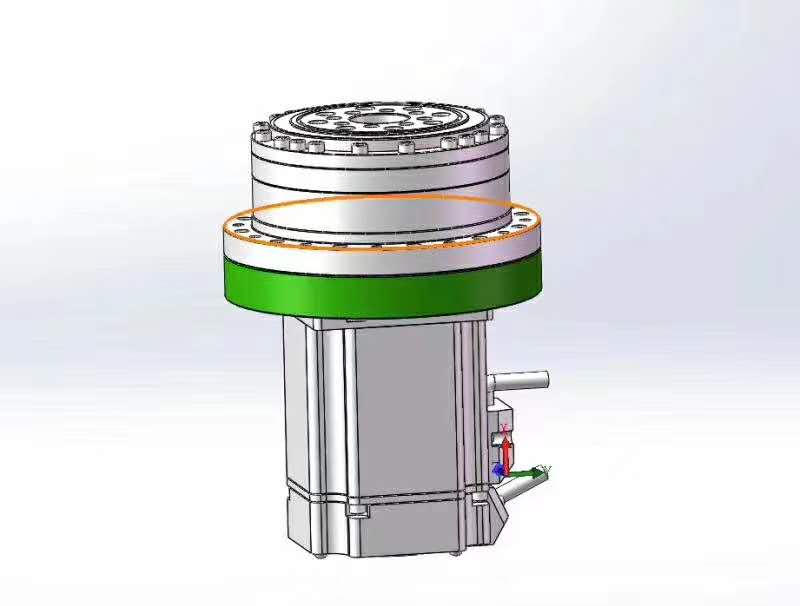
Before assembly, the flexible wheel and its inner hole are circular. After the wave generator is installed into the inner hole of the flexible wheel, due to the length of the wave generator being slightly larger than the diameter of the inner hole of the flexible wheel, the flexible wheel is supported into an oval shape, forcing the flexible wheel to fully mesh with the fixed rigid wheel in the long axis direction of the ellipse and completely separate in the short axis direction. The teeth in other places are either in a "meshing" state or in a "meshing" state depending on the rotation position of the flexible wheel. Due to the fixed rigid wheel, when the wave generator rotates counterclockwise, the flexible wheel rotates clockwise. When the wave generator rotates continuously, the positions of the long and short axes of the flexible wheel, as well as the "meshing" and "meshing out" positions, change continuously. The teeth of the flexible wheel turn from meshing in to meshing out, and then from meshing out to meshing out, and from meshing out to disengagement. In this way, the meshing in, meshing out, disengagement, meshing in, and meshing cycle back and forth, forcing the flexible wheel to rotate continuously.
During the rotation of the flexible wheel with the wave generator, when one of the teeth engages with a tooth on the rigid wheel and then again with this tooth on the rigid wheel, the flexible wheel rotates exactly one turn. At this time, the wave generator rotates many times, and the ratio of the number of turns of the wave generator to the number of turns of the flexible wheel (1 turn) is the reduction ratio of the harmonic gear reducer, so its reduction ratio is very large. During the entire movement process, the deformation of the flexible wheel is a continuous harmonic waveform on the unfolded diagram of the flexible wheel circumference, therefore, this transmission is called harmonic gear transmission.
Harmonic gear reducer can be divided into single wave, double wave and three waves according to the number of mechanical waves, of which double wave transmission is the most commonly used. In harmonic drive, the tooth number difference between rigid wheel and flexible wheel should be equal to an integral multiple of the mechanical wave number, which is usually taken as equal to the wave number.
The difference between harmonic reducer and Rv reducer
What are the key points for selecting a harmonic reducer?
Related Article

Let us go over the foundations of the electroplating procedure. Electroplating involves several phases, and from pre-treatment to post-treatment there are several really significant ones.
The basic principle of surface treatment of precision parts in CNC machining

Audio panels, electronic cigarette shells, nameplateLOG, watch shells, etc. are among the CNC processing of high surface texture needs components.
CNC machining aluminum alloy parts high-quality surface texture process explained in detail

Metallic finishing, sometimes known as metallic finishing, is the process of using several techniques to change the surface of an object in order to improve appearance and performance, such as corrosion resistance, discoloration resistance, chemical resistance, abrasion resistance, and hardness, modify electrical conductivity, remove burrs, or apply a specific color to a machined part.
Metal CNC finishing surface treatment process and its working principle
