
What problems need to be detected before machining with a centrifuge
author: Hansheng Automation
2023-01-09
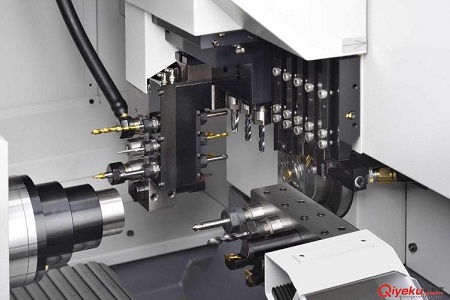
CNC precision automatic lathe processing mainly processes high-precision parts, suitable for processing aerospace parts, electronic components, and other parts. During the processing process, sometimes CNC machine tools may collide with the machine. What is the reason for this? Below, the editor will give you a specific explanation.
1、 Incorrect input of tool diameter and length.
2、 It refers to the input error of related dimensions such as workpiece size and the initial positioning error of the workpiece.
3、 The coordinate system of the parts processed by the CNC precision automatic lathe is not set correctly. During the machining process of the Dongguan CNC precision automatic lathe, the zero point of the machine tool may be reset and changed. Most machine tool collisions occur during the rapid movement of the machine tool, and the harm of collisions is also great at this time. It is necessary to prevent them.
4、 Operators should pay special attention to the initial stage of program and machine tool replacement for CNC lathes. If there are program editing errors, tool diameter and length input errors, collisions are prone to occur. At the end of the program, if the CNC axis retracts in the wrong order, collisions may also occur.
Dongguan CNC machining is a high-precision machining method that utilizes digital information to control the displacement of parts and tools in automated machine tools. It is an effective way to solve the problems of multiple types, small batches, complex shapes, and high accuracy of aerospace product parts, and to achieve automated machining. We need to check before using CNC lathes, so what do we need to check?
1、 Check various interface sockets, servo motor feedback line sockets, spindle pulse generator sockets, manual pulse generator sockets, CRT sockets, etc. If any looseness is found, it should be immediately reinserted and the mechanism locked.
2、 Electrical equipment inspection: Open the electrical control box of the machine tool, check whether the relays, contactors, fuses, servo motor speed, operation unit sockets, spindle motor speed operation unit sockets, etc. are normal and loose. Once released, immediately restore normal status, and lock the plug-in of the locking mechanism tightly.
3、 Check the wiring of all buttons, switches, and indicator lights on the operation panel. If any errors are found, immediately handle them, and check the sockets and wiring of the cathode ray tube unit. Check the required good grounding wire, measure the grounding wire of the CNC lathe, and ensure that the grounding resistance does not exceed 1. Check the input power sequence using a sequence table to ensure that the input power sequence is the same as the calibrated power sequence on the machine tool.
4、 Inspection of solenoid valves: All solenoid valves should be manually pushed several times to avoid poor operation caused by prolonged power outage. If any abnormalities are found, they should be recorded so that repair or replacement can be allowed after power on.
5、 Check the limit switches of CNC machine tools, check whether all limit switches are flexible and fixed firmly. If any movement or fixation is found to be poor, it should be dealt with immediately. Check the buttons and switches on the operation panel for buttons and switches.
What are the places where precision parts processing reflects high-quality
Is the quality of precision parts represented by the machining accuracy
Related Article

Let us go over the foundations of the electroplating procedure. Electroplating involves several phases, and from pre-treatment to post-treatment there are several really significant ones.
The basic principle of surface treatment of precision parts in CNC machining

Audio panels, electronic cigarette shells, nameplateLOG, watch shells, etc. are among the CNC processing of high surface texture needs components.
CNC machining aluminum alloy parts high-quality surface texture process explained in detail

Metallic finishing, sometimes known as metallic finishing, is the process of using several techniques to change the surface of an object in order to improve appearance and performance, such as corrosion resistance, discoloration resistance, chemical resistance, abrasion resistance, and hardness, modify electrical conductivity, remove burrs, or apply a specific color to a machined part.
Metal CNC finishing surface treatment process and its working principle
