
What determines the precision of small-scale CNC machining
author: Hansheng Automation
2023-04-14
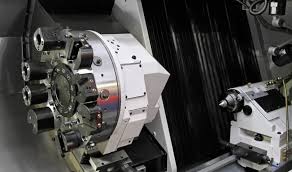
In the programming of CNC machining, the proper use of methods and techniques is of great significance in ensuring and improving the machining accuracy of CNC machine tools. So what determines the accuracy of CNC machining? The machining accuracy of CNC machine tools is determined by position detection components, which are composed of detection components (sensors) and signal processing devices, and are an important component of the closed-loop servo system of CNC machine tools.
Its function is to detect the actual values of the position and speed of the workbench, and send feedback signals to the CNC or servo devices, thus forming a closed-loop control. Detection components generally use the principles of light or magnetism to detect position or speed.
The position detection components are divided into direct measurement components and indirect measurement components according to the detection method. When measuring the linear movement of a machine tool, a linear detection element is generally used, which is called direct measurement. The position closed-loop control formed is called full closed-loop control. The measurement accuracy mainly depends on the accuracy of the measuring components and is not affected by the transmission accuracy of the machine tool.
Due to the precise proportional relationship between the linear displacement of the machine tool workbench and the rotation angle of the driving motor, the method of driving and detecting the rotation angle of the motor or screw can be used to indirectly measure the movement distance of the workbench. This method is called indirect measurement, and the position closed-loop control formed is called semi closed-loop control.
The measurement accuracy of CNC machining depends on the accuracy of the detection components and the feed transmission chain of the machine tool. The machining accuracy of closed-loop CNC machine tools is largely determined by the accuracy of position detection devices. CNC machine tools have very strict requirements for position detection components, and their resolution is usually between 0.001 and 0.01mm or less.
The probability of detecting component failures is relatively high compared to CNC devices, often resulting in cable damage, component fouling, and collision deformation. If it is suspected that there is a fault with the detection component, it is necessary to first check for wireless cable breakage, dirt, deformation, etc. The quality of the detection component can also be determined by measuring its output. This requires proficiency in the working principle and output signal of the detection component. Let's take an example to illustrate, for example, what should be done when the detection device malfunctions and oscillates mechanically (during acceleration/deceleration)?
1) The pulse encoder has malfunctioned. At this point, check if the voltage of the feedback line terminal on the speed unit drops at a certain point. If there is a decrease, it indicates that the pulse encoder is faulty and should be replaced.
2) The pulse encoder cross coupling may be damaged, causing the shaft speed to be out of sync with the detected speed. The coupling should be replaced.
How to handle the machining accuracy of large CNC machining centers
What are the reasons for the significant fluctuations in CNC machining in large CNC processing plants
Related Article

Let us go over the foundations of the electroplating procedure. Electroplating involves several phases, and from pre-treatment to post-treatment there are several really significant ones.
The basic principle of surface treatment of precision parts in CNC machining

Audio panels, electronic cigarette shells, nameplateLOG, watch shells, etc. are among the CNC processing of high surface texture needs components.
CNC machining aluminum alloy parts high-quality surface texture process explained in detail

Metallic finishing, sometimes known as metallic finishing, is the process of using several techniques to change the surface of an object in order to improve appearance and performance, such as corrosion resistance, discoloration resistance, chemical resistance, abrasion resistance, and hardness, modify electrical conductivity, remove burrs, or apply a specific color to a machined part.
Metal CNC finishing surface treatment process and its working principle
