
What are the types of gear drives for harmonic reducers?
author: Hansheng Automation
2023-05-09
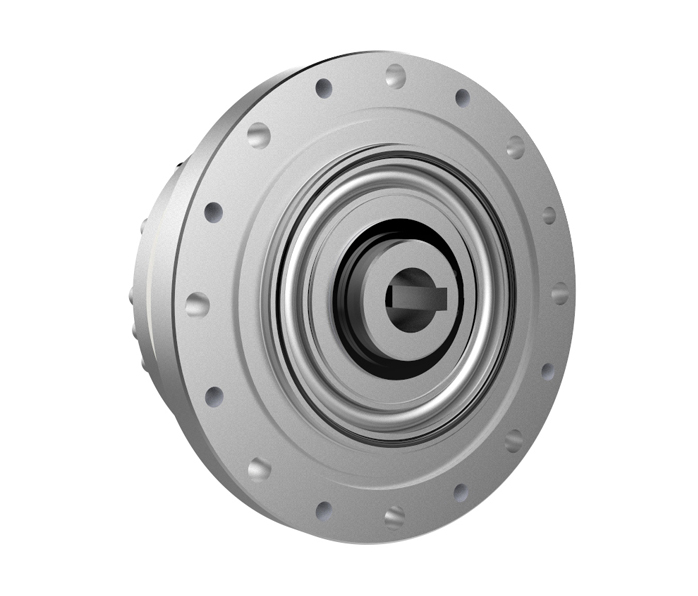
The harmonic reducer has a series of advantages such as large transmission ratio, simple structure, small volume, light weight, and high accuracy. Harmonic gear transmission technology and devices are widely used in fields such as radar communication, industrial robots, precision machine tools, instruments, textile printing, precision optical equipment, medical devices, etc. So what are the types of harmonic drives and what are the classifications?
1、 According to the principle of action of flexible wheels and wave generators, they are classified into electromagnetic coupling type and mechanical connection type. The electromagnetic coupling type of flexible wheel deformation force is generated by electromagnetic coupling between the wave generator and the coil on the circumference of the flexible wheel of the uniform device. Mechanical linkage is the movement of a flexible wheel caused by mechanical force.
2、 According to the configuration of the harmonic reducer wave generator relative to the flexible wheel, it is classified as an external wave generator and an internal wave generator. The external wave generator has a large structural size and large moment of inertia, making it unsuitable for high-speed use. When using a fixed deformation wave generator, an internal type is generally used.
3、 According to the transmission form, it is classified as end face harmonic gear transmission, radial harmonic gear transmission, and harmonic spiral transmission. The end face harmonic gear drive is a type of spatial meshing transmission, which has a smaller axial size and a larger torsional stiffness of the flexible wheel. Radial harmonic gear transmission belongs to the planar meshing type and is currently the most widely used.
4、 Classified as single wave, double wave, and three wave transmissions based on the number of deformation waves. The wave number of harmonic reducer gear transmission refers to the number of cycles in which the wave generator rotates one revolution and a certain point on the flexible wheel deforms. The deformation of the flexible wheel in single wave gear transmission is asymmetric, so the design requirements for tooth profile and wave generator cam profile are too high. The difference in the number of teeth between the flexible and rigid wheels of the double wave gear transmission is 2, and the structure is relatively simple, making it the most commonly used. The three waves have good neutrality and small eccentricity error, but the processing is complex, and the number of repeated bending of the flexible wheel increases, resulting in a relatively low fatigue life of the flexible wheel. Usually rarely used.
With the development of the times and the continuous updating and upgrading of industrial intelligent robots, medical devices, wireless communication, CNC machine tools and other equipment, the requirements for the transmission of harmonic reducers will also become higher. Studying the classification of harmonic gears helps to select and use more suitable types of harmonic reducers.
How to choose and purchase harmonic reducers?
Why is a harmonic reducer called harmonic?
Related Article

Let us go over the foundations of the electroplating procedure. Electroplating involves several phases, and from pre-treatment to post-treatment there are several really significant ones.
The basic principle of surface treatment of precision parts in CNC machining

Audio panels, electronic cigarette shells, nameplateLOG, watch shells, etc. are among the CNC processing of high surface texture needs components.
CNC machining aluminum alloy parts high-quality surface texture process explained in detail

Metallic finishing, sometimes known as metallic finishing, is the process of using several techniques to change the surface of an object in order to improve appearance and performance, such as corrosion resistance, discoloration resistance, chemical resistance, abrasion resistance, and hardness, modify electrical conductivity, remove burrs, or apply a specific color to a machined part.
Metal CNC finishing surface treatment process and its working principle
