
Optimize your CNC design

In order to guarantee that the prototype and production part manufacturing process is fast and cost-effective, we need the ability to balance CNC machining and optimize part design. There are several key considerations for the CNC design process for our milling and turning processes, which will speed up production cycle times and reduce the final cost.
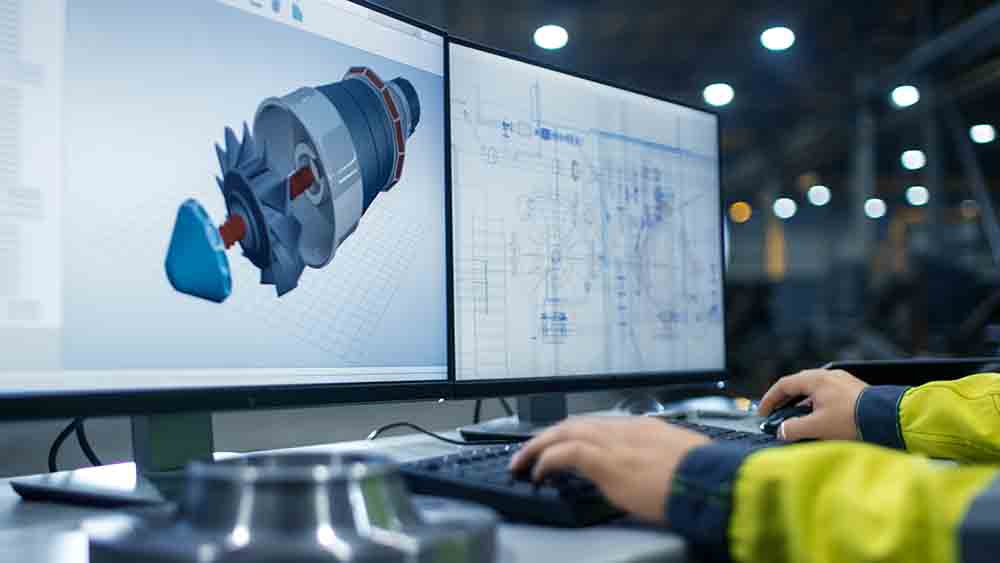
Optimize your CNC design
Six Factors Influence CNC Design
To optimize your machining process design, you should focus on 6 elements:
- Hole depth and diameter
- Wall height and feature width
- Thread size and type
- Power tool lathes
- Text on the part
- Multi-axis milling
Hole features
Anyone who is a machining center will be familiar with what a drill bit looks like and what it does. In most cases, we will be using an end mill or drill jack. In this case, the end mill machining method will use the same tool to provide great flexibility in terms of hole size and a better surface finish than the drilling option. End mill machining also encourages us to use the same tools for grooving and pocketing, reducing cycle times and final production costs. The only drawback is that end mills face challenges when milling deep holes with diameters greater than 6. Due to the limited length of the end mill, we need to machine the sides of two parts.
Threading
Drilling and threading always go hand in hand, and most machining centers use taps to cut internal threads. The tap looks like a toothed screw and is screwed into the previous drilled hole. Now, we have applied a more advanced method of thread fabrication, a new tool called a thread milling cutter for interpolating thread profiles. This creates precise threads, and a single cutter can cut threads of any size with the same pitch, saving production and set-up time. As a result, UNC and UNF threads up to 12.5mm and metric threads from M2 to M12 can be produced using a single toolset.
text
In most cases, customers want to add part numbers, descriptions, logos to the surface of the part, and Hansheng Automation is able to process any text that we need for the limit. The spacing between individual characters and the width of the characters should be at least 0.5mm. Due to the short operation time, we recommend using recessed text instead of raised text. The most appropriate text font is a 20-point Arial, Verdana, or similar Sans-serif font.
Walls
Because our toolset consists of high-carbide cutting tools, this super-rigid metal has the longest tool life and productivity with minimal distortion. However, even the strongest tools can deflegate, especially for machining high-strength steels. As a result, wall heights and feature sizes are tightly limited by individual part geometries and application toolsets. For example, at Runsheng, we have a minimum feature thickness of 0.5mm and a maximum depth of 50mm, but that doesn't mean we can produce these sizes of ribbed heat sinks in your design.
Electrified tools in lathes
We also offer power tools CNC turning, and these toolsets are similar to our machining centers. This encourages us to machine eccentric holes, slots, planes, and other parallel or perpendicular features and follow the design rules of our machining centers. The difference is in the shape of the raw material, with turned parts starting with round raw materials, while milled parts are replaced by square or rectangular blocks.
There are some obvious parts in the turning process of a lathe, such as a piston or hydraulic joint in a slide valve. All of these components are cylindrically symmetrical, with complex external geometries and challenging internal features. CNC lathes can produce these parts in the most cost-effective way. However, regardless of the lathe's live tooling capabilities, a rectangular valve body with a large milled surface, an inner cavity, and intersecting holes will never be rotated by the lathe.
This is the main reason why we add end mills to our CNC turning centers in order to produce a better surface finish on cylindrical features at a usually lower price. This lathe has also increased the efficiency of our manufacturing of special parts that require edge skating in the milling process. It is especially suitable for small batch production.
Since turned parts have several advantages over milling, such as the longer length diameter on the piston, which is more difficult to produce in the milling process but easy on the lathe. Once you have a design concept for your next project, we can provide you with the best turning prototype for your geometry requirements.
3- and 5-axis machining
At Hansheng Automation, 3-axis machining is used, where all workpieces are grabbed from the bottom area of the raw material blank and all features are cut from 6 orthogonal edges. For large parts over 250mm, we can only machine the top and bottom areas. With 5-axis machining, any feature form of a non-orthogonal edge is possible. The toolset is the same in both cases, with the only difference being the raw material
Design limitations of CNC machining
CNC milling machine
Related Article


