
How to take effective measures to reduce thermal deformation in CNC machining centers
author: Hansheng Automation-kk
2023-05-19
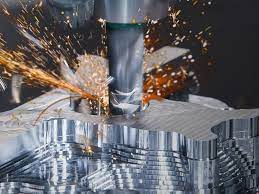
Over time, machining centers are prone to thermal deformation, which can affect machining accuracy and stability. Why does thermal deformation occur? What measures do we have to deal with thermal deformation in machining centers? Today, let's take a look together. We mainly have the following measures for thermal deformation in machining centers.
1、 Reduce heat generation in machining centers
The internal heating of the machining center is the main heat source that generates thermal deformation, and the heat source should be separated from the host as much as possible. At present, most CNC machining centers have external motors, gearboxes, hydraulic devices, and oil tanks. For heat sources that cannot be separated from the host machine, such as spindle bearings, screw nut pairs, high-speed motion guide rail pairs, etc., it is necessary to improve their friction characteristics and lubrication conditions to reduce heat generation inside the machining center.
The spindle component is a key component that directly affects machining accuracy, and the bearings on the spindle are usually a large internal heat source. In addition to using precision rolling bearings and oil mist lubrication for bearings, static pressure bearings can also be used on CNC machine tools, which are beneficial for reducing the temperature rise of the spindle. The use of heating components such as friction clutches should be avoided as much as possible in the spindle box of precision CNC machining centers.
The chips generated during machining in the machining center are also a heat source that cannot be ignored. CNC machines that generate a large amount of chips must be equipped with complete chip removal devices to quickly remove heat. Insulation panels can also be installed on the workbench or guide rail to isolate this heat from the machine tool.
On a CNC machining center using Cutting fluid, Cutting fluid cools the tool and workpiece and takes away the cutting heat. When it is scattered around the machine tool, local temperature rise will also occur. The precision CNC machine tool should control the temperature of Cutting fluid and allow Cutting fluid to be discharged from the machine tool in the shortest way.
Lubricating oil flows between transmission components, taking away frictional heat, gradually increasing the temperature of the lubricating oil pool and becoming a secondary heat source. Therefore, in some precision CNC machining centers, the lubricating oil pool has been removed from the machining center, and of course, temperature control of the oil pool can also be carried out.
The hydraulic transmission system and its oil pool are another secondary heat source for machining centers. In addition to moving this oil pool out of the machining center as much as possible, the oil supply volume of the oil pump must be selected appropriately, otherwise excess oil from the large 4 will flow through the overflow valve, which not only wastes energy but also generates a lot of heat. Therefore, for hydraulic systems that require frequent changes in oil supply, variable displacement pumps should be used as much as possible.
2、 Control the temperature of the machining center
After taking a series of measures to reduce heat sources, the thermal deformation situation will be improved, but it is usually very difficult or even impossible to completely eliminate the internal and external heat sources of the machining center. Therefore, it is necessary to control the temperature rise through good heat dissipation and cooling to reduce the impact of heat sources.
A more effective method is to perform forced cooling on the heating part of the machining center. Currently, for multi axis CNC machine tools, it is difficult to reduce the impact of thermal deformation using compensation methods due to their high precision requirements in several directions.
For this type of machine tool, using a refrigeration system to forcibly cool the lubricating fluid can achieve good results. But the cooling capacity of the refrigeration system must be appropriate. If the heat absorption is greater than the heating capacity of the internal heat source of the machining center, it will cause the temperature of the machining center to be lower than the ambient temperature, not only causing shrinkage, but also causing wet air to condense on the surface of the machine tool, causing the machining center to rust.
Why are there still parts processing in molds now
Leading enterprise ABB is taking action again, and industrial robots are never stopping their expansion path
Related Article

Let us go over the foundations of the electroplating procedure. Electroplating involves several phases, and from pre-treatment to post-treatment there are several really significant ones.
The basic principle of surface treatment of precision parts in CNC machining

Audio panels, electronic cigarette shells, nameplateLOG, watch shells, etc. are among the CNC processing of high surface texture needs components.
CNC machining aluminum alloy parts high-quality surface texture process explained in detail

Metallic finishing, sometimes known as metallic finishing, is the process of using several techniques to change the surface of an object in order to improve appearance and performance, such as corrosion resistance, discoloration resistance, chemical resistance, abrasion resistance, and hardness, modify electrical conductivity, remove burrs, or apply a specific color to a machined part.
Metal CNC finishing surface treatment process and its working principle
