
How to Mill Non circular Gears in Precision Parts Processing
author: Hansheng Automation
2023-05-16
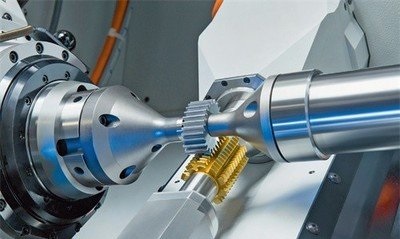
When the polar axis of the pitch curve of a non circular gear is not a tooth groove, but a tooth peak in precision part machining, the angle between the polar axis and the radial direction of the starting machining tooth groove A should be considered when adjusting and calculating. This angle is equal to the angle corresponding to the arc length of half the tooth pitch (π m/2) from the polar axis to the adjacent tooth groove.
When selecting the number of milling cutter numbers, it is necessary to first require the close circle radius (curvature radius) of the midpoint of the arc length of the cut tooth groove on the pitch curve, and then calculate the equivalent number of cylindrical gears for each tooth groove based on the modulus m of the cut gear to select the module milling cutter number. If the accuracy requirement is not high, the number of milling cutter can be selected based on the equivalent gear teeth with the maximum curvature radius.
In order to facilitate tool alignment in precision parts processing, machining should start from the end of the long sleeve with teeth and grooves. After alignment, cutting can be carried out without the need for indexing. After milling the tooth groove on the first arc according to the angle A1 index around the rotation center O1, rotate the angle A2, and then move the rotation center to the center O2 of the second arc. Turn around angle A3, mill out the first tooth groove 3 on the second arc, and then mill all the tooth grooves on the second arc according to angle A4 indexing. Following the same operation sequence as above, mill out all the teeth slots.
How to Measure Roundness Error in Precision Parts Processing
Two minutes to learn about Dongguan Turning and Milling Compound Processing Machine Tool
Related Article

Let us go over the foundations of the electroplating procedure. Electroplating involves several phases, and from pre-treatment to post-treatment there are several really significant ones.
The basic principle of surface treatment of precision parts in CNC machining

Audio panels, electronic cigarette shells, nameplateLOG, watch shells, etc. are among the CNC processing of high surface texture needs components.
CNC machining aluminum alloy parts high-quality surface texture process explained in detail

Metallic finishing, sometimes known as metallic finishing, is the process of using several techniques to change the surface of an object in order to improve appearance and performance, such as corrosion resistance, discoloration resistance, chemical resistance, abrasion resistance, and hardness, modify electrical conductivity, remove burrs, or apply a specific color to a machined part.
Metal CNC finishing surface treatment process and its working principle
