
How to grind the inner circle,What are the methods for grinding the inner circle
author: Hansheng Automation
2023-05-10
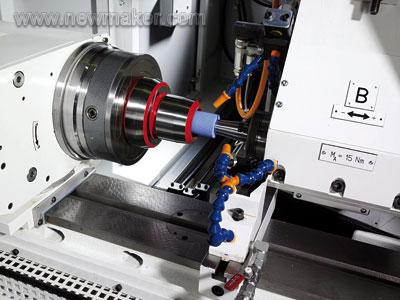
In grinding processing, internal circle grinding is also a very common type of processing. Internal circle grinding can process through holes, through holes, step holes, etc. on machine parts, and is therefore widely used in mechanical processing. The dimensional accuracy of machining can generally reach tolerance levels IT6-IT7. If high-precision grinding technology is used, the dimensional accuracy can be controlled within 0.005mm. So, what are the methods of inner circle grinding?
1、 The form of internal grinding
Internal grinding can be divided into three forms:
1. Center type inner circle grinding
During grinding, the workpiece rotates around the centerline of the main shaft of the spindle box. Both ordinary internal grinding machines and universal external grinding machines belong to this form and are suitable for grinding the inner holes of components such as sleeves, gears, flanges, etc.
2. Planetary internal grinding
During grinding, the workpiece is fixed and does not rotate. In addition to high-speed rotation around its own axis, the grinding wheel also rotates at a lower speed around the center of the grinding hole to achieve circular feed; In addition, the grinding wheel also performs longitudinal feed motion and periodic transverse feed. The lateral feed of the grinding wheel is achieved by increasing the turning radius of the planetary motion. Planetary internal grinding machines are mainly used for grinding parts with large volume and difficult to rotate.
3. Centerless inner circle grinding
On a centerless internal grinding machine, the workpiece is supported on the supporting and pressing wheels by its finely machined outer circle, and is driven by the guide wheel to rotate. This grinding method is suitable for grinding the inner holes of thin-walled circular parts.
2、 Characteristics of Internal Grinding
Compared with cylindrical grinding, internal grinding has the following characteristics:
1. During internal grinding, the diameter of the grinding wheel used is small, and the speed of the grinding wheel is limited by the speed of the internal grinding tool. Therefore, the grinding speed is generally between 20-30m/s. Due to the low grinding speed, the roughness value of the workpiece surface is not easily reduced.
2. During internal grinding, because the grinding wheel contacts the workpiece in a inscribed circle, the contact arc between the grinding wheel and the workpiece is larger than that of external grinding, so the grinding heat and force are relatively large, the abrasive grains are easy to blunt, and the workpiece is easy to heat or burn.
3. During internal grinding, the cutting fluid is not easy to enter the grinding area; Grinding debris is also not easily discharged. When grinding debris accumulates in the inner hole of the workpiece, it is easy to cause grinding wheel blockage and affect the surface quality of the workpiece. Especially when grinding brittle materials such as cast iron, grinding chips and cutting. Mixing the liquid into a paste is more likely to clog the grinding wheel and affect its grinding performance.
4. The rigidity of the grinding wheel extension shaft is relatively poor, which is prone to bending deformation and vibration, which has a significant impact on machining accuracy and surface roughness, and also limits the improvement of grinding amount.
3、 Method of Internal Grinding
The position of the grinding wheel must be adjusted before grinding. When grinding inner holes on a universal cylindrical grinder, the grinding wheel contacts the front wall of the hole. At this point, the transverse feed direction of the grinding wheel is the same as when grinding the outer circle. On an internal cylindrical grinding machine, the grinding wheel contacts the back wall of the hole, making it easy for the operator to observe the surface using longitudinal grinding method.
The longitudinal method and the cutting method are commonly used in internal circle grinding.
1. Longitudinal grinding method
This grinding method is the same as the cylindrical longitudinal grinding method. When grinding through holes, first select the grinding wheel diameter and extension shaft based on the workpiece aperture and length. The rigidity of the extension shaft is better, and the length of the extension shaft only needs to be slightly greater than the length of the hole.
2. Cut in grinding method
This grinding method is the same as the cylindrical cutting grinding method and is suitable for grinding workpieces with shorter inner hole lengths, resulting in higher production efficiency.
When using the cutting in method for grinding, the rigidity of the extension shaft is better, and the grinding wheel is prone to blockage and dullness during continuous feeding. Therefore, the grinding wheel should be repaired in a timely manner. A lower cutting speed should be used during precision grinding.
Key points of lean production in machining
The difference between the principle of a gearbox and a frequency converter
Related Article

Let us go over the foundations of the electroplating procedure. Electroplating involves several phases, and from pre-treatment to post-treatment there are several really significant ones.
The basic principle of surface treatment of precision parts in CNC machining

Audio panels, electronic cigarette shells, nameplateLOG, watch shells, etc. are among the CNC processing of high surface texture needs components.
CNC machining aluminum alloy parts high-quality surface texture process explained in detail

Metallic finishing, sometimes known as metallic finishing, is the process of using several techniques to change the surface of an object in order to improve appearance and performance, such as corrosion resistance, discoloration resistance, chemical resistance, abrasion resistance, and hardness, modify electrical conductivity, remove burrs, or apply a specific color to a machined part.
Metal CNC finishing surface treatment process and its working principle
