
Design limitations of CNC machining

CNC machining is a popular manufacturing process because it can produce a wide variety of parts, from simple shapes to complex structures. However, like every manufacturing technology, CNC machining has some design limitations.We've broken them down below to ensure that your product is optimized to meet our CNC machining capabilities.
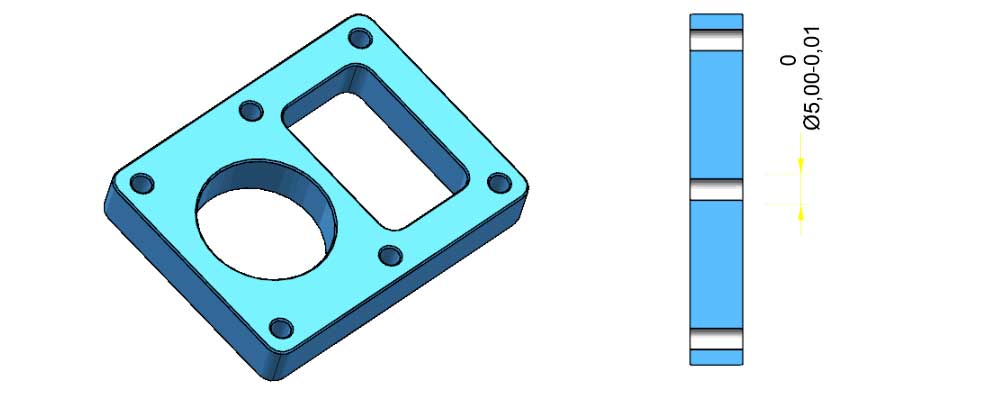
tolerance
When submitting a production design, it's a good idea to include acceptable ranges or tolerances for each part size. Tolerances must be confirmed to meet the functional requirements of a given part.
Although very tight tolerances can be achieved with CNC machining, it's important to remember that tighter tolerances than our service standards often result in longer production times and higher costs.
If no specific tolerances are specified in the product design, Rapid direct maintains standard tolerances of +/- -.005 for metal parts and +/- .010 for plastic parts. Tighter tolerances are possible, but may take more time to implement as the RPM rate must be lowered to account for higher accuracy.
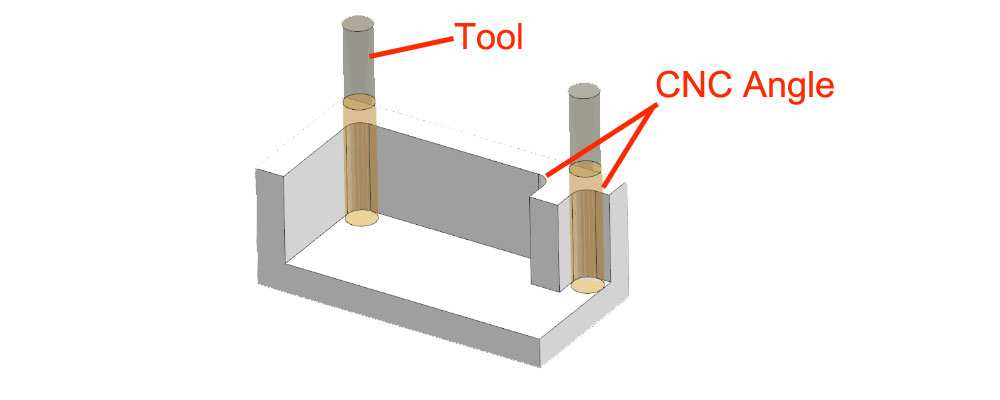
angle
With CNC milling, it is important to know that all internal vertical edges or walls will have a radius, not a right angle. This is because the tools used in CNC milling are cylindrical, which means they cannot produce straight edges. This type of corner is called an inner corner fillet.
When designing parts, taking into account the inner corner fillet can make the production process more efficient. For example, it is advisable to specify a non-standard radius to allow the cutter to cut and turn freely without stopping and repositioning. In addition, corner milling with a larger radius is faster and less costly than a corner with a smaller radius.
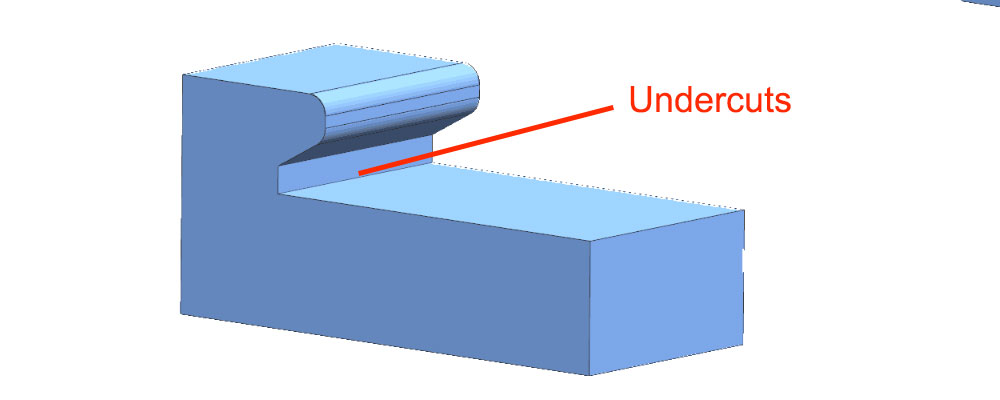
Undercut
Since machining cannot be done with standard milling cutters, the use of retract grooves should be avoided when CNC machining. First of all, if there is no standard size for the chamfer geometry, customized machining tools need to be produced, which will greatly increase the machining time and cost. So, if a custom part needs to be trimmed, make sure it has a standard size.
Secondly, due to the limited length of the CNC tool, the undercut cannot be made too deep. If it's too deep or the location is hard to reach, we won't be able to produce them because CNC tools won't be able to access them.
Wall thickness
As with other manufacturing processes, CNC machining is important to ensure that your part is designed to meet the minimum wall thickness. In general, it is advisable to choose the thickest one and avoid very thin or characteristic walls. This is because the thin or thin nature of CNC tools is prone to vibration, which can cause interruptions or damage. The standard minimum wall thickness for CNC machining is 0.030 inches (~0.76 mm) for metal and 0.060 inches (~1.5 mm) for plastic.
line
If the part has been machined to a specified size and shape, adding threads can be achieved by using cutting taps, forming taps, or thread milling cutters. When designing a part, it is useful to choose the largest possible thread size, as smaller taps have a higher risk of cracking during the production process.
If possible, avoid deep threads as well, as deep holes can lead to higher production costs (if custom tooling is required). Similarly, sticking to custom thread sizes in part design can help reduce costs and production time.
CNC milling
In the quick guide, we offer a range of CNC machining services, including one of the most common CNC processes: CNC milling.In the process of CNC milling, a material blank is installed on the machine and one of the cutting tools, such as an end mill, rotates to cut the raw material. These tools rotate at extremely fast speeds, thousands of revolutions per minute (RPM), to remove material from the final part.
Quick tips for CNC milling
Stick to rounded inside corners: Since circular rotary tools are used in the CNC milling process, it is not possible to create sharp inside corners.
Use the largest possible radius: The larger the tool you use, the faster you can remove the material. Make sure that the maximum possible inner radius is integrated into the design, which will help in the milling process.
CNC turning
The material blank is mounted on a rotating chuck. CNC turning process.When the stationary tool works, the chuck will move the parts. CNC lathes are ideal for producing parts that are symmetrical along the central axis. They are often faster and less expensive than CNC milling products.
Quick tips for CNC turning
Stay away from sharp inside corners: Similar to CNC milling, CNC turning can also machine outer and inner fillets.
Symmetrical, but not too thin or too long: If the part is designed to be too long or too thin, the rotation can become unstable during production, leading to manufacturing problems.
The difference between chrome plating, zinc plating, and nickel plating
Optimize your CNC design
Related Article


