
The basis of resin processing! About injection molding
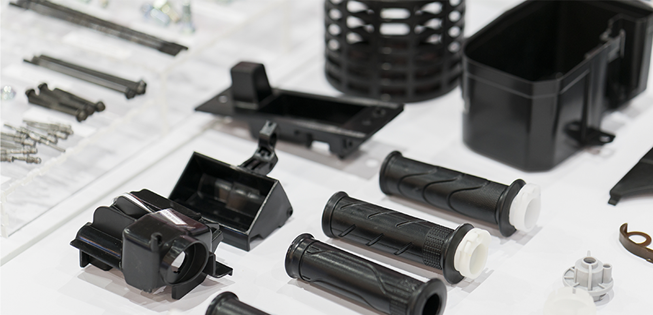
Resin products, also known as plastic products, are widely used in everyday products, electronic equipment, and machine housings because they are lightweight, strong, and easy to produce in large quantities. In this article, we will introduce injection molding, which is the most commonly used method for processing resin products.
What is Injection Molding
We call the production of plastic products "resin processing". In resin processing, thermoplastic resins are used that soften when heated. The granular resin material is heated and melted and then injected into a mold made of metal. However, resin in the molten state is very viscous and viscous unlike liquids such as water, so it must be injected with an external force such as a syringe. Therefore, resin processing is also called "injection molding".
• Resin processing - gate
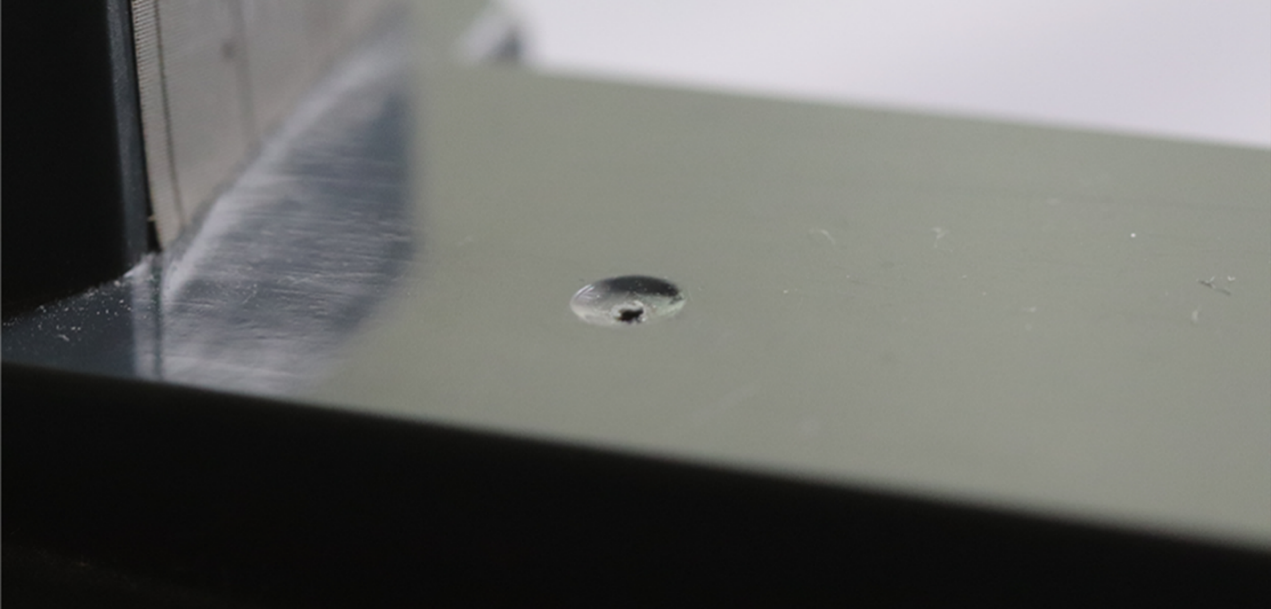
You will find protruding shapes in resin products, as shown in the photo, which are the marks of the injection point of the resin, called the gate.
The mold is divided into two parts, and the mold that is usually used to manufacture the appearance side of the resin product is called the cavity, while the mold located inside is called the core. In resin processing, the mold is heated to a temperature that does not immediately cool and solidify the resin when the upper and lower molds are combined together. Then, the resin is injected into it. Wait for a few seconds until the resin inside cools and solidifies, then open the mold. Then, the finished resin product is pushed out from the inside of the mold using an ejector pin and removed from the mold.
• Resin processing - thimble marks
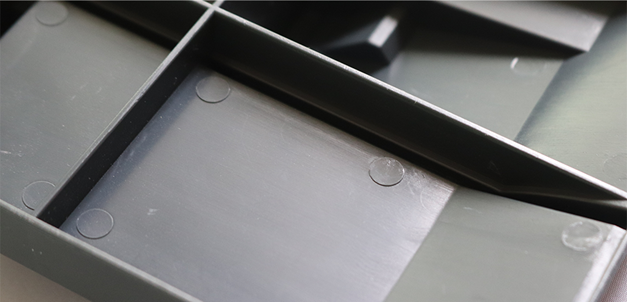
A common circular mark on the back of a resin product is a thimble mark, as shown in the figure.
Conditions for injection molding
The molding conditions of resin processing are the key to determining the quality of resin parts
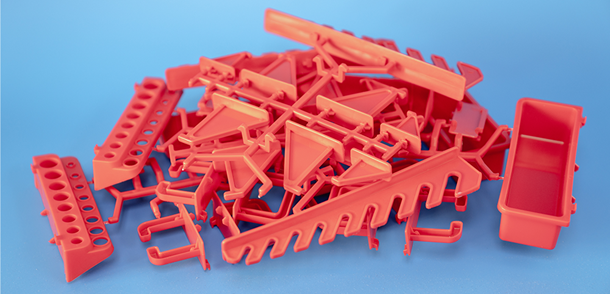
In the injection molding process, the molten resin is injected into the mold while pressurized, the resin fills the mold, and when the resin cools and solidifies, the mold is opened and the finished part is taken out. But it doesn't mean that all injection molding processes are always under the same conditions, and the same resin can be injected. For example, when cutting wood with a saw, if it is soft wood, it can be cut without much force. However, if it is a hard wood, you can only cut it bit by bit by moving the saw blade repeatedly and vigorously. This difference is known as the "condition of processing". In resin processing, processing conditions, such as resin pouring speed and filling pressure, must also be varied depending on the type and shape of the resin material used. If the right conditions are not selected, it can lead to defects such as the resin not flowing in the mold or the resin part not coming out of the mold. In addition, even if it is not a functional defect, it may lead to appearance defects such as surface texture not being reproduced smoothly and visible resin dents after cooling. Therefore, it is very important to find the right molding conditions during the trial production stage in the injection molding process.
There are many factors that affect the molding conditions of resin processing, but here are a few typical ones.
・Mold temperature
For general injection molding, the mold temperature is 15°C~90°C. When the mold temperature is low, the incoming resin begins to solidify from the time it touches the mold. Therefore, if there are parts around the resin that are not easy to form, such as thin shapes, the mold temperature should be set higher. However, if the mold temperature is too high, it will also cause defects, such as the resin solidifying time for a long time, and the gas generated by the resin will corrode the mold, etc., and it is also possible to improve the mold by installing exhaust inserts, but it is better not to let the mold temperature go too high.
・Resin temperature
The temperature of the resin injected into the mold is also important. Basically, the higher the temperature, the lower the viscosity of the resin, so it is easier for the resin to penetrate into the small parts of the mold. However, if the temperature is too high, the resin will deteriorate, and the volume difference during cooling and hardening will be larger, which is the main cause of "sink marks" dents. In addition, due to the low viscosity of the resin, the resin may flow into the ejector pins, inserts and mold gaps, causing burrs.
・Filling speed
Ideally, the resin fills at the same speed from the beginning of the mold to the end of filling, but in practice it is difficult to achieve in most cases. If the resin flows too slowly, a short shot of resin that cannot be filled will occur, and the resin flow marks will turn into streaks, causing cosmetic defects such as flow marks. Conversely, if the resin flows too fast, it will damage the mold, and friction will shorten the life of the mold.
In injection molding, after the resin is injected into the mold, the molding conditions between the cooling and solidification of the resin and the removal of the part from the opening of the mold are also important. There are two representative conditions that determine the status at this time.
・Hold pressure
In injection molding, when the mold is filled with resin, the nozzle continues to apply pressure, and this pressure is called packing. If the holding pressure is low, the sink marks on the back of the rib will be noticeable, and the shrinkage will become larger when cooling, and the desired size may not be secured. Conversely, too high holding pressure can create burrs or prevent molded parts from being released.
・Cooldown time
Although the resin that is heated dissolves and becomes viscous, in order for the resin parts to be able to be removed from the mold, it must be cooled and the resin solidified. This period of time is called the cooldown. The longer the cooldown, the greater the shrinkage and the smaller the size is likely to be. In addition, cooling time accounts for a large proportion of the processing cycle, so the longer the cooling time, the longer the processing cycle, which leads to higher product costs. Conversely, if the cooling time is too short, defects such as deformation may occur when ejecting a part with a thimble.
Injection molding can produce parts of various shapes, but some shapes cannot be produced, and representative examples are as follows.
• Thin-walled shapes that are too thin cannot be produced because the highly viscous resin cannot flow into the mold sufficiently. Depending on the type and shape of the resin, it is generally considered that a thickness of 1 mm or less is a matter of concern.
• Vertical wall injection molding requires a certain "draft angle" in order to remove the molded parts from the mold. As a result, even seemingly vertical walls are sloped in shape that gradually thickens towards the roots. Vertical shapes without draft slopes cannot be produced.
• UndercutSince the mold is open upwards and downwards, it is not possible to produce shapes that hinder the direction of movement of the mold. For example, a bulge inside a façade or a hole in the side. Such a shape is called an undercut, commonly known as "UNDER", and cannot be produced directly.
• Sharp corners without R-angles Mold for resin molding is made by machining and carving a metal block and adding various mold parts to it. Tools for processing metal are all rounded, and cannot make a right angle where the face is opposite to the face. As a result, injection molding is also not possible to produce pointers without R-angles. In addition, from the point of view of resin flow, it is not recommended to produce sharp corner shapes.
Injection molding is one of the most common resin processing methods. Familiarity with the methods of injection molding and its characteristics helps to design and develop better resin part shapes
Understanding the "Fit Tolerances" for Precision Hole Notes
Gate types and characteristics used in resin injection molds
Related Article


