
Analysis of Grinding Technology for End Face Cutting Edge of End Mills in Five Axis Machining Centers
author: Hansheng Automation
2022-05-02
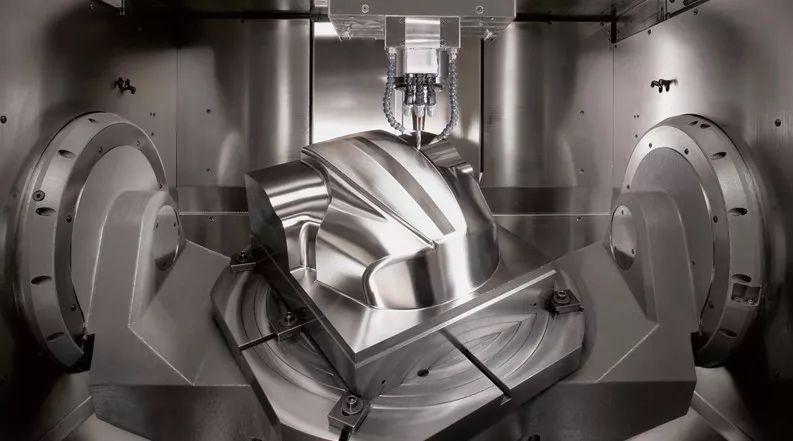
No matter how many edge end mills are used in the five axis machining center, the first step is to grind the end face of the blade perpendicular to the axis, which is the key to ensuring that the outstanding points of the five axis machining center blade can be in the same plane. Before grinding the five axis machining tool, it is necessary to inspect the grinding wheel. If any issues such as grinding wheel runout, irregular cylindrical surface, or excessive rounded corners are found, they need to be repaired.
Generally, the cylindrical surface of the grinding wheel can be repaired using a grinding wheel corrector (such as a diamond corrector or a tooth blade corrector), or a waste grinding wheel with relatively high abrasive hardness can be used for repair. If the side plane of the grinding wheel is no longer flat, the grinding wheel can be replaced.
Generally, the cylindrical surface of the grinding wheel can be repaired using a grinding wheel corrector (such as a diamond corrector or a tooth blade corrector), or a waste grinding wheel with relatively high abrasive hardness can be used for repair. If the side plane of the grinding wheel is no longer flat, the grinding wheel can be replaced.
Firstly, when grinding each edge separately, use the tip of each edge as the benchmark and keep the tip as the principle. Grind the front angle (without chipping), back angle, secondary back angle (if large cutting volume requires good strength, it is recommended to add a large blade wedge angle in front of the grinding tool), and the edge inclination angle.
Secondly, the selection of angles involves a rear angle of 6 ° to 8 °, and a blade inclination angle of 1 ° to 3 ° (with a secondary rear angle of 30 ° to 45 °). The selection of the back angle depends on the hardness of the workpiece, and if the material hardness is high, the angle will be smaller; The principle for selecting the angle of blade inclination is that all four blades must be concave in the middle, and the flatter the angle, the better the roughness accuracy. At this point, the deeper the machining depth (such as greater than 2mm but within the allowable range), the better the roughness accuracy will be, because the entire cutting edge is involved in the cutting result.
Then, after the grinding of the five axis linkage machining tool is completed, the milling tool is erected on a five axis machining center platform. If the axis is vertical, all the blade tips can be leveled, and the deviation angle of the blade can be aligned evenly. This way, the five axis CNC machining tool can meet the requirements.
In addition, five axis machining machine tools can also be calibrated with a 90 ° square on a flat plate, and after leveling, observe whether there is a gap or even gap between the milling cutter and the square. Generally, observe the two relatively high feet first (the two feet that touch the bottom first), and if they are not perpendicular, polish the higher feet until the two opposite feet are the same height (i.e. perpendicular).
At this point, there is a height difference between these two feet and the other two opposite feet, and the milling cutter will swing and lower the two higher feet at the same time. Similarly, rotate the milling cutter 90 ° again to observe the verticality of the other two opposite feet, so that all four feet touch the bottom at the same time and make the milling cutter perpendicular.
In manual sharpening of the five axis machining center, the height and angles of the blade are not easy to grasp. During training, it should vary from person to person, as long as you pay attention to grinding a little back corner. If the top edge is uneven, it is only necessary to make the blade tip outstanding. In addition, if it is not for the case of cleaning the inner cavity, a chamfer greater than 0.2mm can be ground at the blade tip to increase the strength of the blade tip.
What are the principles for selecting benchmarks in precision parts machining
Analysis of Factors Influencing the Cutting Efficiency of CNC Lathes in Large CNC Processing Plants
Related Article

Let us go over the foundations of the electroplating procedure. Electroplating involves several phases, and from pre-treatment to post-treatment there are several really significant ones.
The basic principle of surface treatment of precision parts in CNC machining

Audio panels, electronic cigarette shells, nameplateLOG, watch shells, etc. are among the CNC processing of high surface texture needs components.
CNC machining aluminum alloy parts high-quality surface texture process explained in detail

Metallic finishing, sometimes known as metallic finishing, is the process of using several techniques to change the surface of an object in order to improve appearance and performance, such as corrosion resistance, discoloration resistance, chemical resistance, abrasion resistance, and hardness, modify electrical conductivity, remove burrs, or apply a specific color to a machined part.
Metal CNC finishing surface treatment process and its working principle
