
What are the errors and improvement measures caused by thermal deformation in the precision parts processing process system?
author: Hansheng Automation
2023-05-18
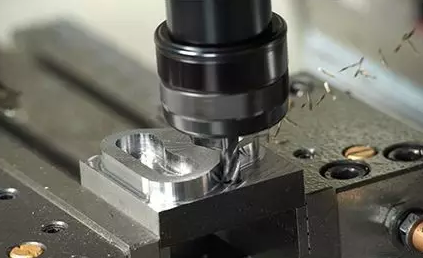
During the machining and cutting process of precision parts, the entire process system is often affected by cutting heat, friction heat, and external radiation heat, resulting in complex deformations that lead to the relative position, motion, and transmission accuracy between the previously adjusted workpiece and the cutting edge. The deformation phenomenon of the process system caused by this reason is known as proof of industrial practice. The main factors affecting the thermal deformation of the process system are the thermal deformation of the machine tool, cutting tool, and process system.
(1) The main factor affecting the thermal deformation of machine tools is the heat generated by the energy loss conversion of motors, electrical appliances, and mechanical power sources; The frictional heat generated during the movement of transmission components and moving components; Cutting debris or cutting fluid transferred by cutting heat that falls on the machine tool; Radiative heat from the outside world. These heat sources can more or less deform the bed, workbench, spindle, and other parts. In order to reduce the impact of thermal deformation on machining accuracy, the structural design of large components of machine tools usually adopts symmetrical structures or active control methods to balance the temperature of the machine tool. Reduce bending or deformation caused by heating in key areas. In the design of structural join, the layout should make the thermal deformation direction of key components have less influence on the machining accuracy. In order to reduce the impact of thermal deformation on machining accuracy during precision parts processing, the structural design of large machine tools usually adopts symmetrical structures or active control methods to balance the temperature of key parts, in order to reduce the impact on machining accuracy. Bending or deformation caused by heating during processing; In the design of structural join, the thermal deformation direction of key parts should have little effect on the machining accuracy.
(2) The thermal deformation of the workpiece occurs during the machining process due to the influence of cutting heat, and its thermal expansion affects the dimensional and shape accuracy.
Therefore, in order to reduce the impact of thermal deformation on machining accuracy in precision parts processing, the method of cooling the cutting zone with cutting fluid is often used; It is also possible to reduce cutting heat or heat transfer to the workpiece by selecting appropriate cutting tools or changing cutting parameters; For large or long workpieces, the end should be able to freely expand and retract in the clamping state.
Two minute understanding, three methods for determining machining allowance in precision parts processing
Five Methods for Machining Conical Surface of Precision Parts on Lathe
Related Article

Let us go over the foundations of the electroplating procedure. Electroplating involves several phases, and from pre-treatment to post-treatment there are several really significant ones.
The basic principle of surface treatment of precision parts in CNC machining

Audio panels, electronic cigarette shells, nameplateLOG, watch shells, etc. are among the CNC processing of high surface texture needs components.
CNC machining aluminum alloy parts high-quality surface texture process explained in detail

Metallic finishing, sometimes known as metallic finishing, is the process of using several techniques to change the surface of an object in order to improve appearance and performance, such as corrosion resistance, discoloration resistance, chemical resistance, abrasion resistance, and hardness, modify electrical conductivity, remove burrs, or apply a specific color to a machined part.
Metal CNC finishing surface treatment process and its working principle
