
Will the next trillion yuan market belong to industrial robots+AIGC?
author: Hansheng Automation
2023-05-18
The term "Artificial Intelligence Generated Content (AIGC)" has been heard by many recently. Against the backdrop of the accelerating integration of the digital age and the physical world, AIGC is leading a major transformation. The AIGC model led by ChatGPT is sweeping the world, and artificial intelligence generation is slowly evolving into an indispensable force for the future comprehensive progress towards digital civilization. In the industrial field, the application of AIGC is also keeping up with the pace, injecting new energy into industrial development.
Recently, PIX Moving, an autonomous skateboard chassis and vehicle development and manufacturing company, announced that it has opened its internal testing application for its AI industrial design tool PAM, which is known as the "ChatGPT of the industry" and is the first landing of the "Industry+AIGC" in China.
According to Yu Chuan, founder and CEO of PIX Moving, PAM can increase the efficiency of component design by 60%, and its design efficiency in lightweight can be as high as 20% or more compared to mature engineers. Under traditional industrial processes, it takes about 3-4 professional engineers several months to design a qualified car chassis, while using intelligent generation applications only requires one professional engineer to operate independently for a few days to complete the design. Both in terms of labor and time costs, it is a tenfold increase. The most essential optimization of industrial manufacturing is to reduce complex processes and use intelligent generation applications, This has been achieved by simplifying the structure of the components.
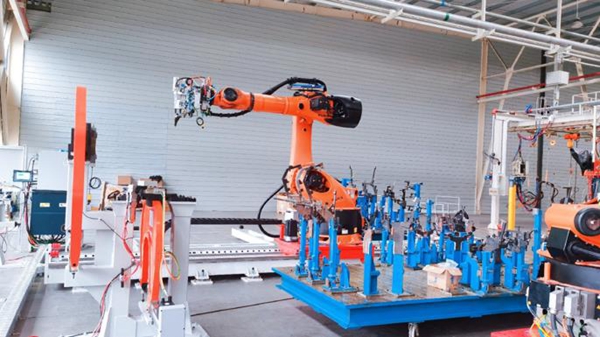
Industrial robots can utilize technology that generates content using artificial intelligence to achieve better results. At present, industrial robots are commonly used in automated production lines to perform repetitive and high-precision tasks, such as welding, assembly, cutting, etc. The use of artificial intelligence to generate content technology can help industrial robots better understand tasks on the production line, automatically generate task related programs, instructions, or reports, making the application of industrial robots more replicable and high degree of freedom.
For example, industrial robots can use artificial intelligence technology to analyze data such as images, sound, and text to learn and understand product features and quality requirements, and then automatically generate suitable production programs and instructions to ensure the efficiency and accuracy of the production line. In addition, using artificial intelligence to generate content technology can also help industrial robots collect and analyze data on production lines to optimize production processes and improve production efficiency.
At the same time, the application of industrial AIGC can help factories complete tasks such as intelligent quality inspection, robot programming, process optimization, and industrial document generation. For example, visual recognition algorithms generated using artificial intelligence technology can help industrial robots automatically detect product quality, inspect product surface defects, size deviations, and provide timely feedback to operators or factory systems; Using artificial intelligence technology to generate robot programming can enable industrial robots to quickly switch and adapt to production lines. Some robot manufacturers use programming tools generated by artificial intelligence technology to enable robots to quickly and automatically complete the programming and debugging of new products.
By analyzing and learning data such as intelligent quality inspection on the production line, AIGC can generate guidance strategies for optimizing the production process, output corresponding parameters to the robot, and enable industrial robots to have the ability to self adjust. This helps industrial robots optimize the production process, improve production efficiency, and reduce costs. At the same time, the use of AIGC can also help industrial robots automatically generate relevant production instructions, reports, and records. With this data and the support of artificial intelligence generation, industrial robots can automatically generate maintenance guidance, troubleshooting, and maintenance manuals during maintenance and repair processes, helping engineers solve problems faster. In this way, after-sales service can be guaranteed and the cost of after-sales service for robot companies can be reduced.
According to Yu Chuan, founder and CEO of PIX Moving, a generation tool for the B-end industrial design field can be applied in scenarios such as architecture, automotive manufacturing, aerospace, etc. It has strong universality in the overall industrial field, and AIGC application scenarios can also be found on the C-end. For example, for furniture product design, regardless of whether the user has a professional design background, they can design furniture products with practical application value based on size and style requirements, And transfer to the manufacturing factory to complete production. From the perspective of software supply, the current global industrial AIGC market size is estimated to be over 400 billion US dollars in stock market. In the future, with more and more applications targeting C-end users, it may also bring greater growth, and it is expected that the market size will reach trillions of US dollars.
Artificial intelligence generation of content technology provides intelligent and automated support for industrial robots, which can improve production efficiency, reduce production costs, and improve the flexibility and safety of production lines. Adding artificial intelligence generation to industrial production can also reduce human errors and provide more accurate data support for enterprises. In the future, in the era of AIGC blooming, the digital industry will also take off on this fast train.
With the rapid development of the collaborative robot market, what are the winning secrets of card saving robots?
Leading and promoting the development of the robot industry in a new stage, Moying Technology debuted at the Shanghai Electronics Exhibition in Munich, igniting the entire venue!
Related Article

In order to create new products that are constantly emerging on the market, we use different methods to process various materials.
What is Molding Processing? We will introduce some representative molding processing methods

In the context of vehicle electrification and intelligence, human-computer interaction with consumer experience and intelligent control as the core has become an important development theme of intelligent cockpits. The on-board display is at the core of the intelligent cockpit, benefiting from the continuous development of the Internet of Vehicles and smart cars, the on-board display will usher in new development opportunities.
Lighting up new opportunities for automotive electronics - all at the 2025 Guangzhou International Automotive Intelligent Cockpit and Vehicle Display Technology Event

The 2025 Asia International Power Semiconductor, Materials and Equipment Technology Exhibition will focus on "Focusing on Cutting-edge Technology Breakthroughs and Empowering Industrial Innovation and Integration". It will be held on November 20-22, 2025 at Guangzhou Poly World Trade Center Expo!
Focus on the power semiconductor industry - APSME 2025 Asia International Power Semiconductor, Materials and Equipment Technology Exhibition will be held in Guangzhou

Lexey's multi-axis bus stepper drivers – 2DM3/2CL3-EC (open/closed-loop) dual-axis series and 4DM3/4CL3-EC (open/closed-loop) four-axis series are innovative technologies designed to solve the above problems and help your equipment to achieve efficient upgrades.
"Three provinces" drive: Leisai multi-axis bus stepping, opening a new chapter in the miniaturization and upgrading of precision equipment