
Why is a harmonic reducer called harmonic?
author: Hansheng Automation
2023-05-09
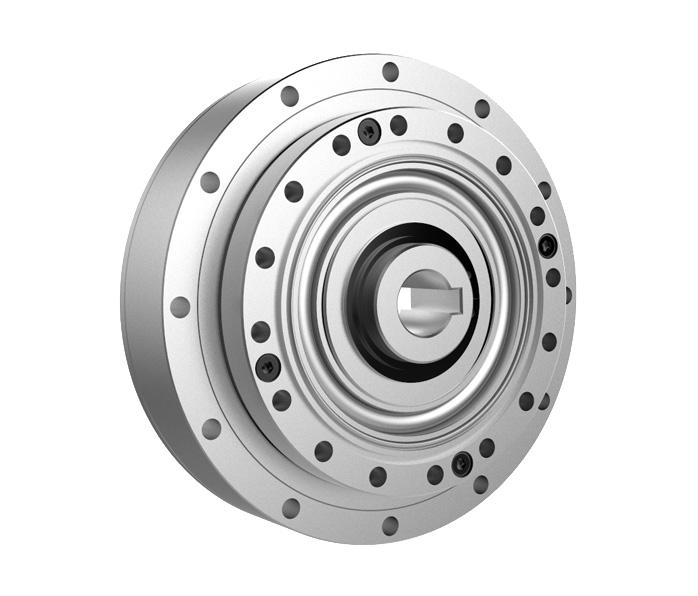
Why is a harmonic reducer called harmonic? First, it is necessary to understand what harmonic transmission is, so as to know the name source of the harmonic reducer. The specific process is as follows:
Harmonic drive utilizes a constructed controllable elastic deformation to achieve the transmission of mechanical motion. Harmonic drive usually consists of three basic components, including a rigid wheel with internal teeth, a flexible wheel with external teeth that can generate radial elastic deformation during operation, and a wave generator installed inside the flexible wheel, which is elliptical in shape and has flexible rolling bearings on the outer ring. The number of outer teeth of a flexible wheel is less than the number of inner teeth of a rigid wheel. When the wave generator rotates, the corresponding outer teeth of the flexible wheel in the long axis direction completely mesh into the inner teeth of the rigid wheel; In the short axis direction, the outer teeth are fully disengaged from the inner teeth. When the rigid wheel is fixed and the wave generator rotates, the outer teeth of the flexible wheel will sequentially mesh in and out of the inner teeth of the rigid wheel. The radial displacement of any point on the flexible wheel gear ring will exhibit a change similar to a sinusoidal waveform, so this type of transmission is called harmonic transmission.
Harmonic reducer is a type of harmonic transmission device, which includes harmonic accelerator and harmonic reducer.
Harmonic reducers mainly include: rigid wheels, flexible wheels, and wave generators, none of which are indispensable.
Among them, the number of teeth of the rigid wheel is slightly greater than that of the flexible wheel.
The length of the wave generator is larger than the diameter of the undeformed inner circle of the flexible wheel: when the wave generator is installed into the inner circle of the flexible wheel, it forces the flexible wheel to undergo elastic deformation and become elliptical, causing the teeth of the flexible wheel at its long axis to be inserted into the groove of the rigid wheel teeth, becoming a fully engaged state; And the two wheel teeth at its short shaft are completely out of contact and in a disengaged state. The process from engagement to disengagement is in a state of engagement or engagement.
When the wave generator continuously rotates, it forces the flexible wheel to continuously deform, causing the teeth of the two wheels to constantly change their respective working states during the process of meshing, meshing, meshing, and detachment, resulting in the so-called staggered tooth motion, thereby achieving the motion transmission between the active wave generator and the flexible wheel.
What are the types of gear drives for harmonic reducers?
What should I pay attention to when using a gear reducer?
Related Article

Let us go over the foundations of the electroplating procedure. Electroplating involves several phases, and from pre-treatment to post-treatment there are several really significant ones.
The basic principle of surface treatment of precision parts in CNC machining

Audio panels, electronic cigarette shells, nameplateLOG, watch shells, etc. are among the CNC processing of high surface texture needs components.
CNC machining aluminum alloy parts high-quality surface texture process explained in detail

Metallic finishing, sometimes known as metallic finishing, is the process of using several techniques to change the surface of an object in order to improve appearance and performance, such as corrosion resistance, discoloration resistance, chemical resistance, abrasion resistance, and hardness, modify electrical conductivity, remove burrs, or apply a specific color to a machined part.
Metal CNC finishing surface treatment process and its working principle
