
Why do slender shafts bend during precision part machining
author: Hansheng Automation
2023-05-15
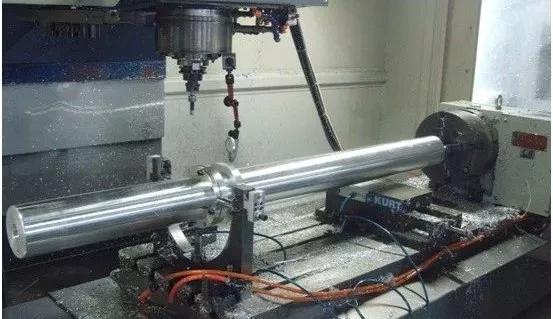
When turning slender shafts in the field of precision parts processing, due to the poor rigidity of the workpiece itself, improper adjustment of auxiliary tools such as the center frame and tool holder can result in unsatisfactory geometric shape and surface quality, leading to bending.
The workpiece has a large specific diameter and poor rigidity; The radial cutting force and centrifugal force during turning generate thermal deformation, elongation, and cutting stress on the workpiece; The raw material itself is a deformed rod, and various reasons can cause the workpiece to bend.
The solution is to use a center frame and a tool holder to increase the rigidity of the workpiece; Reasonably select the geometric angle of the cutting tool (mainly large rake angle and major deviation angle) to reduce radial cutting force and reduce the generation of cutting heat; Use spring tips to reduce the adverse effects of linear expansion of the workpiece, fully pour cutting fluid, reduce friction and quickly remove the generated heat, and perform necessary heat treatment on the blank or workpiece.
If there is bending of the blank material itself or during the processing of precision parts, it should be straightened in a timely manner before continuing turning. According to specific needs, appropriate methods such as hot forging straightening, cold pressing straightening, counterattack straightening, counterattack straightening, prying straightening, simple tool straightening, quenching straightening, and torsion groove straightening can be selected.
Quality issues that are prone to occur in the powerful cutting of multi head worm gears in precision parts processing
What are the processing difficulties of composite materials in the process of turning and milling composite processing
Related Article

Let us go over the foundations of the electroplating procedure. Electroplating involves several phases, and from pre-treatment to post-treatment there are several really significant ones.
The basic principle of surface treatment of precision parts in CNC machining

Audio panels, electronic cigarette shells, nameplateLOG, watch shells, etc. are among the CNC processing of high surface texture needs components.
CNC machining aluminum alloy parts high-quality surface texture process explained in detail

Metallic finishing, sometimes known as metallic finishing, is the process of using several techniques to change the surface of an object in order to improve appearance and performance, such as corrosion resistance, discoloration resistance, chemical resistance, abrasion resistance, and hardness, modify electrical conductivity, remove burrs, or apply a specific color to a machined part.
Metal CNC finishing surface treatment process and its working principle
