
What turning tools are needed to process different threads for precision parts
author: Hansheng Automation
2023-05-17
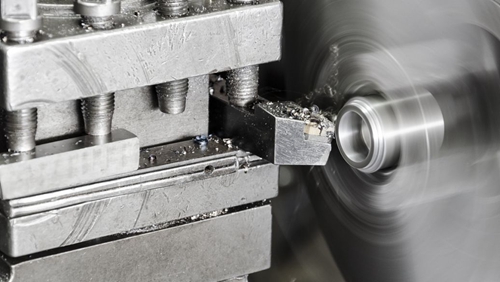
In the processing of precision parts, when using high-speed steel turning tools to turn threads at low speeds, if a turning tool with a back rake angle Yp equal to zero degrees is used, it is difficult to remove chips and smooth the thread tooth surface. Therefore, threaded turning tools with a back rake angle of 5 °~15 ° can be used. However, when the turning tool has a back rake angle, the tooth angle can easily change. At this time, the method of correcting the tool tip angle should be used to compensate for the tooth angle error.
A thread turning tool with a back and front angle can cut smoothly and reduce chip buildup, enabling the turning of threads with lower surface roughness values. However, due to the cutting edge not passing through the workpiece axis, the thread profile (axial profile) being cut is not a straight line, but a curve. This error can be ignored for threads with generally low requirements, but it has a significant impact on the tooth angle, especially for thread turning tools with large rake angles, whose sharp angle must be corrected. When turning triangular threads, when grinding a thread turning tool with a back rake angle of 10 °~15 °, the tool tip angle should be reduced by 40,~1 ° 40,.
If the precision of precision machining requires high threads, the front and back angles should be smaller (0 °~5 °) in order to produce the correct tooth shape.
It must be pointed out that thread turning tools with large rake angles not only produce thread deformation, but also generate a large back force Fp during precision parts machining and turning. This force causes the turning tool to pull towards the inside of the workpiece. If the gap between the sliding plate screw and the nut is large, a phenomenon of "cutting" (broaching) will occur.
How to Reduce Surface Roughness When Using Two Hand Control Method for Precision Parts Processing
Five Points to Pay Attention to for Tool Radius Compensation in Precision Part Processing
Related Article

Let us go over the foundations of the electroplating procedure. Electroplating involves several phases, and from pre-treatment to post-treatment there are several really significant ones.
The basic principle of surface treatment of precision parts in CNC machining

Audio panels, electronic cigarette shells, nameplateLOG, watch shells, etc. are among the CNC processing of high surface texture needs components.
CNC machining aluminum alloy parts high-quality surface texture process explained in detail

Metallic finishing, sometimes known as metallic finishing, is the process of using several techniques to change the surface of an object in order to improve appearance and performance, such as corrosion resistance, discoloration resistance, chemical resistance, abrasion resistance, and hardness, modify electrical conductivity, remove burrs, or apply a specific color to a machined part.
Metal CNC finishing surface treatment process and its working principle
