
What is the usage method of flat jaw vice in precision parts processing
author: Hansheng Automation
2023-05-16
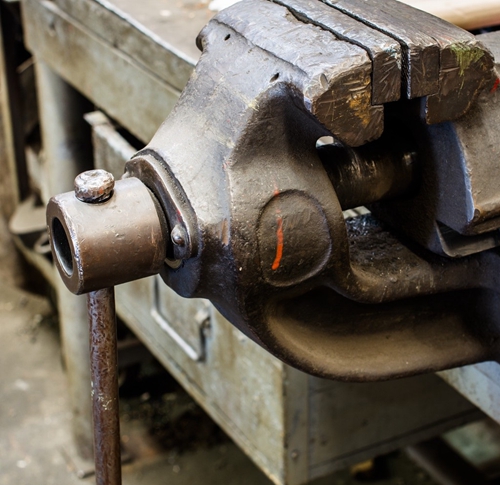
In mass production of precision parts processing, pneumatic or hydraulic vises should usually be used. When using pneumatic or hydraulic vises, one should be familiar with the structure and adjustment method of the vise. For example, in large-scale production, hydraulic vises can be used to effectively reduce labor intensity, stabilize clamping force, and absorb certain vibrations during milling for workpieces with high impact force and heavy self weight.
According to the drawings and instructions, the structural principle of the hydraulic vise is analyzed as follows: during clamping operation, the handle is pulled to the clamping position, and pressure oil enters the oil chamber above piston 2 through control valve 1, pushing piston 2 to move downwards and driving the piston rod 3 connected to it. The piston rod pushes the sliding block 4 with a groove to move, and under the action of the groove and roller 6, the movable jaw seat 5 is pulled to the left to clamp the workpiece.
According to the drawings and instructions, the structural principle of the hydraulic vise is analyzed as follows: during clamping operation, the handle is pulled to the clamping position, and pressure oil enters the oil chamber above piston 2 through control valve 1, pushing piston 2 to move downwards and driving the piston rod 3 connected to it. The piston rod pushes the sliding block 4 with a groove to move, and under the action of the groove and roller 6, the movable jaw seat 5 is pulled to the left to clamp the workpiece.
After the milling stage in the precision part machining process is completed, pull the handle to the released position, the piston retracts, and the jaw is released. When processing another batch of workpieces and adjusting the distance between the two jaws due to changes in workpiece size, the nut at the upper end of the T-shaped column shaft in the middle of the roller seat 7 should be loosened to separate the teeth on the roller end face from the teeth on the movable jaw seat, and the position of the movable jaw can be adjusted.
What are the techniques for CNC precision machining
Troubleshooting Common Mechanical Faults in Precision Parts Processing
Related Article

Let us go over the foundations of the electroplating procedure. Electroplating involves several phases, and from pre-treatment to post-treatment there are several really significant ones.
The basic principle of surface treatment of precision parts in CNC machining

Audio panels, electronic cigarette shells, nameplateLOG, watch shells, etc. are among the CNC processing of high surface texture needs components.
CNC machining aluminum alloy parts high-quality surface texture process explained in detail

Metallic finishing, sometimes known as metallic finishing, is the process of using several techniques to change the surface of an object in order to improve appearance and performance, such as corrosion resistance, discoloration resistance, chemical resistance, abrasion resistance, and hardness, modify electrical conductivity, remove burrs, or apply a specific color to a machined part.
Metal CNC finishing surface treatment process and its working principle
