
What is the impact of tool tip arc on turn-milling composite processing and how to handle it
author: Hansheng Automation
2023-05-15
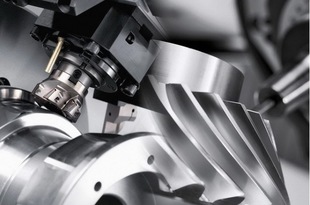
Turning-milling composite machining is a high-tech method for processing hardware parts. It can process various types of materials, including 316 and 304 stainless steel, carbon steel, alloy steel, aluminum alloy, zinc alloy, titanium alloy, copper, iron, plastic, acrylic acid, POM, uhwm and other raw materials, and can be processed into complex structural parts with square and circular combinations. During the use of CNC lathe, in order to reduce the surface roughness of the workpiece to be processed, slow down the tool wear, and improve the tool life, the turning tool tip is usually ground into an arc shape, and the arc radius is generally 0.4~1.6mm. Using CNC lathes (G41, G42) with tool tip radius compensation function, as long as the machining program is directly programmed based on the workpiece size, the tool tip arc will not cause machining errors; CNC lathes without this function will be affected by the tool tip arc during processing. In severe cases, it may cause the workpiece to be out of tolerance and scrapped
Method for Eliminating Machining Errors in CNC Lathes
1. Change programming size: Adjust the tool tip trajectory during programming to ensure that the actual machining contour of the arc tool tip is consistent with the ideal contour
2. Using the arc center of the tool tip as the tool position, the programming steps are as follows: draw a workpiece sketch → draw the arc trajectory of the tool tip based on the arc radius r of the tool tip and the size of the workpiece → calculate the feature points of the arc center trajectory → program. In this process, the drawing of the center trajectory of the tool tip arc and the calculation of its feature points are quite cumbersome. If the cutting machine uses the equidistant line drawing function and point coordinate query function in CAD software to complete this work, it will be very convenient. In addition, when using this method for machining, the operator should pay attention to the following two points: 1) Check whether the R value of the tool tip arc radius used is consistent with the R value in the program; 2) During the tool setting process of turning milling composite machining, the value of R should be considered, that is, if the tool compensation values obtained through tool setting are x (x-axis) and y (Z-axis), the actual tool compensation values that should be input are x-2r and y-r.
CNC precision parts processing characteristics
What are the common faults in the tool library of turning and milling composite processing equipment
Related Article

Let us go over the foundations of the electroplating procedure. Electroplating involves several phases, and from pre-treatment to post-treatment there are several really significant ones.
The basic principle of surface treatment of precision parts in CNC machining

Audio panels, electronic cigarette shells, nameplateLOG, watch shells, etc. are among the CNC processing of high surface texture needs components.
CNC machining aluminum alloy parts high-quality surface texture process explained in detail

Metallic finishing, sometimes known as metallic finishing, is the process of using several techniques to change the surface of an object in order to improve appearance and performance, such as corrosion resistance, discoloration resistance, chemical resistance, abrasion resistance, and hardness, modify electrical conductivity, remove burrs, or apply a specific color to a machined part.
Metal CNC finishing surface treatment process and its working principle
