
What is slow wire processing
author: Hansheng Automation
2023-05-20
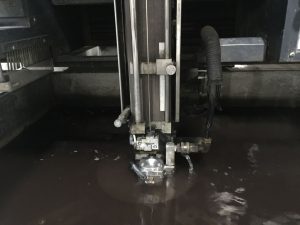
Slow wire machining is a CNC machining machine that uses continuously moving fine metal wires (referred to as electrode wires, usually copper and molybdenum wires) as electrodes to perform pulse spark discharge on the workpiece, generating high temperatures above 6000 degrees Celsius to remove metal and cut it into workpieces. The principle of wire cutting machining is the phenomenon of continuous discharge to remove metal from the gap between the wire electrode and the workpiece.
Due to the fact that the slow wire cutting machine adopts a continuous wire supply method with wire electrodes, and the wire electrodes complete the processing during the movement process, even if the wire electrodes are lost, they can be continuously supplemented, thereby improving the machining accuracy of the parts. The surface roughness of the workpiece processed by the slow wire cutting machine can usually reach Ra=0.8 μ M and above, and the roundness error, straight-line error, and size error of the slow wire cutting machine are much better than those of the fast wire cutting machine. Therefore, when processing high-precision parts, the slow wire cutting machine has been widely used. In addition to early small and medium-sized enterprises, it is also extremely common in processing factories of large enterprises such as aviation, automobiles, and healthcare.
Slow wire machining is a machining machine tool that uses continuously moving fine metal wires (referred to as electrode wires) as electrodes to perform pulse spark discharge to remove metal from the workpiece and cut it into shape. The phenomenon of loose contact light pressure discharge between the wire electrode and the workpiece during slow wire machining. When the flexible electrode wire and the workpiece are close to the commonly considered discharge gap (such as 8-10 μ m) When there is no spark discharge, even when the electrode wire has come into contact with the workpiece and the gap is no longer visible from the microscope, sparks are often not visible. Normal spark discharge only occurs when the workpiece bends the electrode wire and offsets it by a certain distance (several micrometers to tens of micrometers). At this time, every 1 feed of the wire electrode μ m. The discharge gap does not decrease by 1 μ m. Instead, the electrode wire increases the tension between the wires by a little, while the workpiece increases the lateral pressure by a little. Obviously, only after maintaining a certain slight contact pressure between the electrode wire and the workpiece can spark discharge be formed.
The electric discharge wire cutting machine has high machining accuracy and strong functions, but the machining cost is high. To fully utilize the role of the machine tool and create economic benefits, it is necessary to conduct reasonable machining technology analysis and technical performance analysis on the workpiece, be familiar with the structural performance of the machine tool and proficient in machine operation skills, reasonably select water and electrical parameters, reduce machining interruption lines, continuously summarize experiences and lessons in practice, maximize the potential of the machine tool, and improve production efficiency.
Development Trend of Precision Parts Processing
How can aluminum parts be milled without tool marks
Related Article

Let us go over the foundations of the electroplating procedure. Electroplating involves several phases, and from pre-treatment to post-treatment there are several really significant ones.
The basic principle of surface treatment of precision parts in CNC machining

Audio panels, electronic cigarette shells, nameplateLOG, watch shells, etc. are among the CNC processing of high surface texture needs components.
CNC machining aluminum alloy parts high-quality surface texture process explained in detail

Metallic finishing, sometimes known as metallic finishing, is the process of using several techniques to change the surface of an object in order to improve appearance and performance, such as corrosion resistance, discoloration resistance, chemical resistance, abrasion resistance, and hardness, modify electrical conductivity, remove burrs, or apply a specific color to a machined part.
Metal CNC finishing surface treatment process and its working principle
