What is Cylindrical grinding?
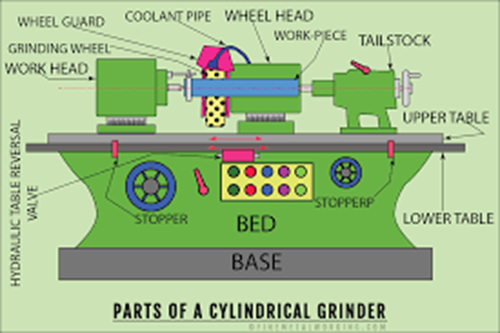
What is Cylindrical grinding?
Cylindrical grinding is one of the more common grinding processes, mainly used for grinding rotationally symmetrical workpieces. Different types of workpiece clamping and feed direction: peripheral cross grinding between centers, peripheral-longitudinal grinding between centers, centerless peripheral grinding, centerless peripheral longitudinal grinding.
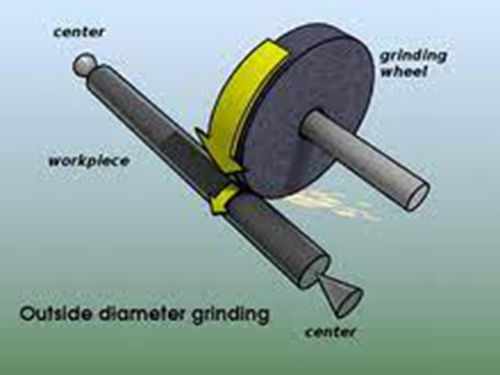
The more common type of clamping in cylindrical grinding is between centers.This means that the workpiece is centered at the front and driven by the workpiece drive. For external cylindrical grinding, long, heavy or thin workpieces are additionally supported with stable supports in order to meet the necessary shape and geometry requirements. In the mass production of tools, such as: drill bits, milling cutters, step drills, etc. are more and more. In this case, the cutting is done with a higher feed, divided into several cuts and reduced feed movements.
In centerless grinding, the workpiece is fixed at 3 points. The fixation consists of a grinding wheel, a control wheel and a support ruler. The workpiece is guided and machined on the periphery at the same time. In centerless plunge grinding, the grinding wheel moves radially towards the workpiece. The following workpieces can be produced with this grinding process: injection needles for injection systems, bearing housings for camshafts, valve lifters for the automotive industry. Shafts and rods for the automotive industry as well as components for the rolling bearing industry are produced by centerless infeed grinding in a typical continuous grinding process.
Features of cylindrical grinding machine tools
Cylindrical grinding machines are precision engineering machines used to shape the outer surfaces of objects. The surface may be contoured or stepped, tapered or straight. A cylindrical grinding machine is no different in operation from a lathe in that it rotates the object to be ground around a central axis. However, instead of cutting metal like a lathe, the machine uses a spinning grinding wheel to grind away excess metal from the spinning object.
Cylindrical grinding machines can be used to achieve precise forming on any number of manufactured components, especially where the inner or outer diameter is to be perfectly rounded. Some other advantages of cylindrical grinding include:
Versatility: Depending on the type of grinding wheel, cylindrical grinding machines can be used on a variety of materials, including aluminum and steel. Likewise, manufacturers can configure these tools to support the production of multiple products.
Ease of use: Modern cylindrical grinding machines are easy to load and unload material and feature efficient automation.
Enhanced Surface Finish: A key consideration in many industries, cylindrical grinding machines support higher finishes than rougher techniques. This saves trimming time, which in turn reduces costs.
These benefits are primarily due to the range of grinding configurations available. Different types and combinations of wheel heads and shafts can work together to support a variety of uses. Manufacturers in all industries are looking to exotic grinding to save money while still producing high quality, high precision parts. Cylindrical grinding often produces similar or even better results than other grinding processes, such as CNC machining, and is also faster.
The use of cylindrical grinder
Cylindrical grinding machines are mainly used for precision grinding of end faces, outer circles and conical surfaces of shaft parts in batches, and are the main equipment in industries such as automobile engines. It is also suitable for processing shaft parts with small batches and high precision requirements in military, aerospace, and general precision machining workshops.
(1) Used in the textile spinning industry, coarse yarn frame, drawing frame, combing machine, texturing machine and other top roller processing.
(2) For the production and manufacture of office communication equipment industry, fax machines, copiers, printers, cutting plotters and other rubber roller processing.
(3) Suitable for printing, food, pharmaceutical industry automatic conveying device top roller, plastic processing.
Influence of Machining Accuracy of Cylindrical Grinding Machine
1. The influence of the height of the grinding head, headstock and tailstock on the dimensional accuracy of the workpiece.
The height error of the grinding head, headstock, and tailstock will cause the center line of the headstock, tailstock and the axis of the grinding wheel spindle to deviate in space. At this time, the surface of the workpiece to be ground will be a hyperboloid.
2. The influence of the connection line between the center of the headstock and the tailstock on the parallelism error of the spindle axis of the grinding head in the horizontal plane on the dimensional accuracy of the workpiece.
When this error occurs, the shape of the workpiece ground by the cylindrical grinder will be a cone, that is, the grinding wheel is ground at an angle, and the surface has spiral grinding lines.
3. The influence of the verticality error of the movement of the grinding head relative to the guide rail of the machine tool on the machining accuracy.
The final result of this error is to make the axis of the spindle deviate from the line connecting the center of the headstock and tailstock, and when grinding the end face of the shaft shoulder, it will cause the perpendicularity between the end face of the shaft shoulder and the axis of the workpiece.
What is CNC drilling?
What is Gear Hobbing?