
What are three types of alarm situations in a five axis machining center factory
author: Hansheng Automation
2022-02-15
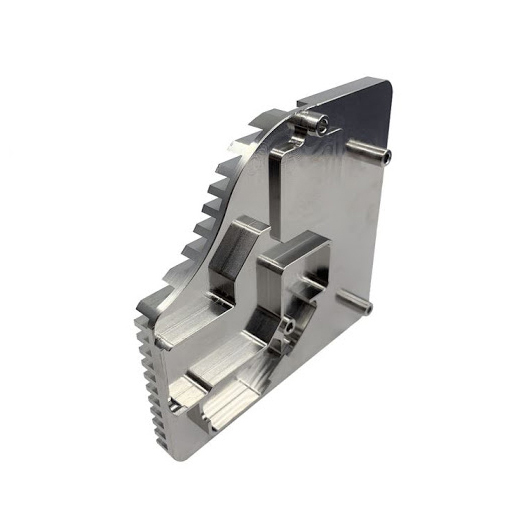
The 5-axis machining center factory adopts a high rigidity structure design, while the X-axis adopts a positioning movable column structure with three guide rails, which have a large load-bearing section, making the machine tool highly rigid and shock-absorbing, ensuring high-precision and high-load cutting processing. The front and rear ends of the high rigidity spindle are equipped with imported high-precision spindle bearings, with ideal span support and appropriate preload applied to ensure the spindle has high-precision, high rigidity, and high-speed rotation capabilities.
Thermal characteristics are one of the important factors affecting the machining accuracy of a vertical five axis machining center. Due to its spindle speed and feed speed being much higher than ordinary machine tools, the impact of hot cutting generated by large cutting amounts on the workpiece and heat conduction is much more severe than ordinary machine tools, and the impact of thermal deformation on machining accuracy is often difficult to be corrected by the operator.
Thermal characteristics are one of the important factors affecting the machining accuracy of a vertical five axis machining center. Due to its spindle speed and feed speed being much higher than ordinary machine tools, the impact of hot cutting generated by large cutting amounts on the workpiece and heat conduction is much more severe than ordinary machine tools, and the impact of thermal deformation on machining accuracy is often difficult to be corrected by the operator.
Today, the editor wants to share with you the alarm situation of a vertical five axis machining center after the spindle is overloaded. It can usually be divided into three types:
1. An alarm occurs when the motor excitation is turned off, and there are several reasons for this situation. For example, if there is an error in parameter setting, it is necessary to determine whether the sensor's setting parameters are correct; If the cable is disconnected, it can also cause this alarm condition, and the cable needs to be replaced at this time. If there is a malfunction in sensor adjustment, it is necessary to adjust the sensor signal accordingly. If there is no way to adjust it, the connected cable or sensor should be replaced.
2. An alarm occurs when the spindle is running or when the cable is touched. The reason for this may be that the wire is broken. At this time, the cable should be replaced. If cutting fluid is found to invade the connector, the user needs to clean it in time.
3. An alarm occurs when the motor is rotating, and the main reason for this situation is a cable shielding processing fault between the sensor and SPM. At this time, it is necessary to confirm the processing of the cable shielding. It is also possible that the cable between the sensor and SPM and the power line of the servo motor have been tied together, and they need to be tied separately at this time.
What are the common drill bit clamping methods used in CNC machining centers
What are the factors that affect the surface roughness of CNC machining
Related Article

Let us go over the foundations of the electroplating procedure. Electroplating involves several phases, and from pre-treatment to post-treatment there are several really significant ones.
The basic principle of surface treatment of precision parts in CNC machining

Audio panels, electronic cigarette shells, nameplateLOG, watch shells, etc. are among the CNC processing of high surface texture needs components.
CNC machining aluminum alloy parts high-quality surface texture process explained in detail

Metallic finishing, sometimes known as metallic finishing, is the process of using several techniques to change the surface of an object in order to improve appearance and performance, such as corrosion resistance, discoloration resistance, chemical resistance, abrasion resistance, and hardness, modify electrical conductivity, remove burrs, or apply a specific color to a machined part.
Metal CNC finishing surface treatment process and its working principle
