
What are the characteristics of non-standard parts processing
author: Hansheng Automation
2022-06-29
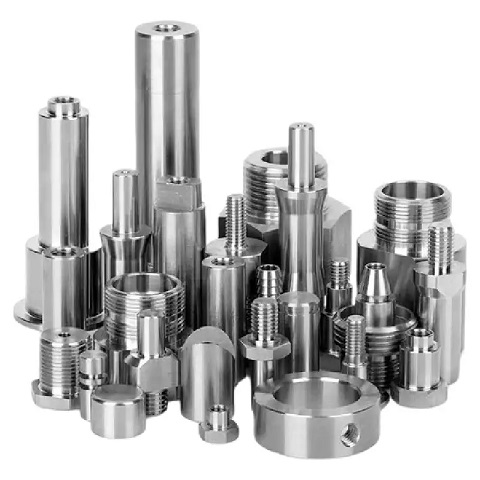
In practical applications, precision parts need to have higher accuracy and more refined appearance in order to better reflect the processing level and quality. Meanwhile, this product is more popular among consumers. Generally speaking, CNC machining has unparalleled advantages and characteristics in mechanical processing, and its product quality is usually high. So what are the characteristics of non-standard parts processing?
1. Firstly, the production efficiency of CNC non-standard parts processing is relatively high. CNC parts processing can simultaneously process multiple surfaces. Compared with ordinary lathe processing, it can save a lot of processes and time, and the quality of parts processed by CNC is much more stable than that of ordinary lathe.
2. CNC non-standard parts processing plays an irreplaceable role in the development of new products. Generally speaking, parts of different complexity can be processed through programming, and modifying and updating the design only requires changing the program of the lathe, which can greatly shorten the product development cycle.
3. The automation level of CNC non-standard parts processing is very high, greatly reducing the physical labor intensity of workers. During the machining process, workers do not need to operate the entire process like ordinary lathes, but mainly observe and supervise the lathes. However, the technological content of CNC machining is higher than that of ordinary lathes, so it requires higher mental labor than ordinary lathes.
4. CNC lathes are expensive, have high maintenance costs, long processing preparation periods, and have a larger initial investment than regular lathes.
In addition, it should be noted that the processing of non-standard parts is not simple. All problems can be solved using high-quality machine tools. It should be a complete set of things, from material processing to heat treatment, to process design, to quality inspection, and then to environmental control.
For example, even if there are equally high specification lathes processing and measuring dimensions on the lathe, everything is designed dimensions, but once the lathe is removed, the residual stress generated by the working conditions in use will lead to dimensional/fit deviations. In addition, the higher the accuracy of small components, the more important the control of environmental variables, such as temperature/humidity/stress distribution/trace dust in the air.
You can imagine a dust-free room in a precision machining center in Germany/Japan. The processing of non-standard parts should combine material processing, advanced control, and servo system/environmental variable control/precision measurement technology. At present, China lacks the accumulation of hard technology for precision servo motors, real-time control systems, and material processing and process standardization.
What are the requirements for the working environment of large CNC machining centers
The Application of Large CNC Machining Centers in Extrusion Mold Processing
Related Article

Let us go over the foundations of the electroplating procedure. Electroplating involves several phases, and from pre-treatment to post-treatment there are several really significant ones.
The basic principle of surface treatment of precision parts in CNC machining

Audio panels, electronic cigarette shells, nameplateLOG, watch shells, etc. are among the CNC processing of high surface texture needs components.
CNC machining aluminum alloy parts high-quality surface texture process explained in detail

Metallic finishing, sometimes known as metallic finishing, is the process of using several techniques to change the surface of an object in order to improve appearance and performance, such as corrosion resistance, discoloration resistance, chemical resistance, abrasion resistance, and hardness, modify electrical conductivity, remove burrs, or apply a specific color to a machined part.
Metal CNC finishing surface treatment process and its working principle
