
Three Classifications of Dongguan Turning and Milling Composite Processing Methods
author: Hansheng Automation
2023-05-17
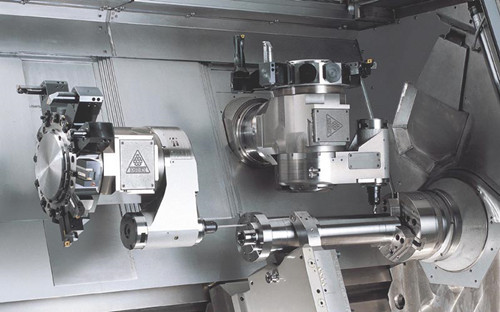
According to the different positions of the workpiece axis and tool axis, there are three processing methods for Dongguan turning and milling composite machining: general turning and milling, axial turning and milling, and orthogonal turning and milling. According to the relative rotation direction between the workpiece and the tool, it can be divided into two different forms: forward milling and reverse milling.
1. Orthogonal turning and milling
Orthogonal turning and milling refers to the rotation axis of the turning and milling cutter perpendicular to the rotation axis of the workpiece. The cutting trajectory of orthogonal turning and milling is a spatial curve, which is relatively complex. When cutting, the eccentricity used varies, and the size of the cutting area also varies. Orthogonal turning milling composite machining is an advanced and efficient method for processing large rotating bodies and slender shaft parts. Unlike traditional machining methods, the instantaneous cutting depth and cutting thickness of orthogonal turning and milling always change along the tool axis and rotation direction, namely variable cutting depth and variable thickness cutting. Because the tool path has a close and complex relationship with many cutting parameters, the optimal combination of these parameters plays an important role in improving and ensuring the surface quality of turning and milling machining. The characteristic of orthogonal turning and milling motion is that the rotational motion of the tool (usually at a higher speed) is the main motion, while the rotational motion of the workpiece (usually at a higher speed) is the feed motion of the milling cutter along the circumferential direction of the workpiece. This unique cutting motion endows orthogonal turning and milling with the following characteristics:
(1) Compared with traditional turning, the radial force that causes workpiece deformation is significantly reduced, which is beneficial for improving the shape accuracy of thin-walled and slender parts. Due to the small cutting force, the load on the machine tool and cutting tools is also small, which is beneficial for maintaining the accuracy of the machine tool.
(2) Orthogonal turning and milling is intermittent cutting, so regardless of the material used in Dongguan turning and milling composite processing, shorter chips can be obtained, making it easy to automatically remove chips.
(3) Intermittent cutting allows the tool to have sufficient cooling time and relatively low cutting temperature.
(4) The workpiece speed is relatively low, and there is almost no deformation caused by centrifugal force when processing thin walls.
(5) The tool has good heat dissipation, and the chips and tools carry more heat away, resulting in a lower workpiece temperature and less thermal deformation.
(6) Multi edge cutting, smooth cutting process, low tool wear, which is very beneficial to the processing of difficult to machine materials and large rotating body blanks.
The rotation axis of the orthogonal turning and milling cutter is perpendicular to the rotation axis of the workpiece, which is an efficient method for processing large rotating bodies and long axis parts. Orthogonal turning and milling cannot process inner holes due to the perpendicular rotation axis between the milling cutter and the workpiece.
2. Axial turning and milling
Axial turning and milling also have the basic advantages of turning and milling processing. Axial turning and milling, as the milling cutter and the rotating axis of the workpiece are parallel to each other, can not only process the outer circular surface, but also the inner hole surface. However, due to the parallel rotation axes, if the diameter of the milling cutter is smaller than the radial size of its main axle box, it limits the longitudinal travel of the milling cutter. In this case, it is not suitable to use axial turning and milling to process outer circular surfaces with longer axial travel or deeper inner hole surfaces.
What are the process design principles for Dongguan turning and milling composite processing
What are the selection principles for Dongguan turning and milling composite processing process standards
Related Article

Let us go over the foundations of the electroplating procedure. Electroplating involves several phases, and from pre-treatment to post-treatment there are several really significant ones.
The basic principle of surface treatment of precision parts in CNC machining

Audio panels, electronic cigarette shells, nameplateLOG, watch shells, etc. are among the CNC processing of high surface texture needs components.
CNC machining aluminum alloy parts high-quality surface texture process explained in detail

Metallic finishing, sometimes known as metallic finishing, is the process of using several techniques to change the surface of an object in order to improve appearance and performance, such as corrosion resistance, discoloration resistance, chemical resistance, abrasion resistance, and hardness, modify electrical conductivity, remove burrs, or apply a specific color to a machined part.
Metal CNC finishing surface treatment process and its working principle
