
This centipede robot solves the problem of dynamic instability
author: Hansheng Automation
2023-06-01
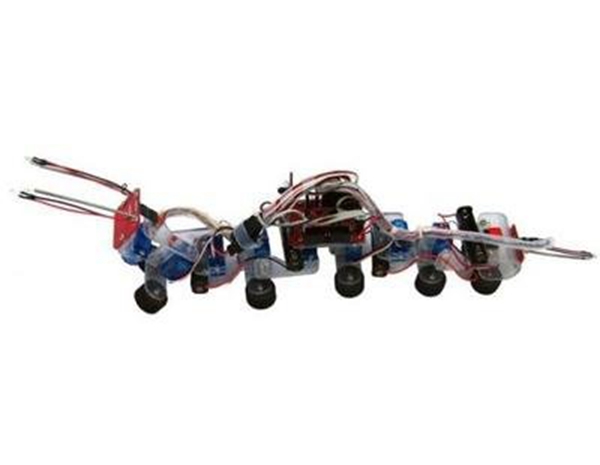
The research team from the Department of Mechanical Science and Bioengineering at Osaka University has developed a new type of centipede shaped robot and demonstrated its curved and straight walking states. This robot can traverse uneven terrain for search and rescue operations or perform exploration missions to other planets in space.
Many animals on Earth possess powerful locomotion abilities. Animals use their legs to demonstrate agile movement and extraordinary land mobility to cross different environments. Inspired by animal movements, researchers have developed many legged robots, hoping to achieve agile movement in various environments through humanoid movements.
Prior to this, NASA Research Institute also released a giant centipede shaped robot, but NASA's main research direction for robots is autonomous navigation in extreme environments without sensor dependence, while Osaka University's robot this time focuses more on the dynamic instability and its solutions generated in the dynamics of multi legged robots.
Although legged robots have excellent ground mobility, when engineers try to imitate humans to create bipedal robots, they find that such robots are unexpectedly fragile. If one of the legs of the bipedal robot malfunctions or is damaged, it will cause the robot to be unable to move.
Among animals, cockroaches exhibit incredible agility using their six legs, while centipedes and millipedes have high traversal ability on rough terrain and high tolerance for falls and leg failures. Therefore, researchers have turned their attention to multi legged robots, allowing robots to move from bipedal to multi legged, solving the problem of continuing walking when one leg of the robot is injured, The design of a multi legged robot can effectively share the overall weight of the robot and can continue to move even if one leg is injured.
Although using a large number of mechanical legs has advantages for legged robots, it can make the robot's body longer, resulting in complex interaction with the environment. Many contact legs are limited by the body to the ground during movement to support the long body, thereby hindering mobility. From a biological and engineering perspective, the potential for agile motion using a large number of legs is unknown, and the maneuvering motion of robots using a large number of legs remains challenging.
The research team at Osaka University has developed a biomimetic "myriapod" robot that takes advantage of dynamic instability and can switch between straight and curved walking. It consists of six parts and flexible joints, each connected to two legs. The coupling composed of adjustable screws is very flexible and can be modified by an electric motor during walking.
The key to this study is the dynamic instability of multi legged robots. In the early stages of research and development, adding joints to the robot can lead to instability when walking straight, and curve walking cannot be accurately controlled. The controllability of the robot is not high, which is also a key direction for engineers to tackle. Subsequently, the research team proposed a control scheme for myriapod robot maneuvering and efficient motion, adding a variable stiffness mechanism to the robot's body axis, which allows the robot to change the flexibility of its body axis and control the bifurcation characteristics during walking. Based on these characteristics, a simple control program was developed to enable the robot to achieve maneuvering and autonomous motion.
This method does not directly control the motion of the body axis, but rather controls the flexibility of the body axis, thus greatly reducing computational complexity and energy requirements during robot motion. Shinya Aoi, a member of the research team, said, "Our inspiration comes from the ability of certain extremely agile insects to control their dynamic instability during movement, leading to rapid changes in movement
It is reported that the robot is mainly composed of standard metal and DC motors, and its appearance is basically hard. Except for the soft nature of the torsion spring in the yaw joint of the body part, it is these soft elements that control the entire dynamics of the robot and create various types of motion, greatly improving performance. This seems to be an advantage found in soft robots.
In the current testing on the hard floor, the R&D team has collected a lot of data on the controller's maneuverability and improved motion efficiency of the multi legged robot. The next step is to verify the relevant design in a more complex environment. The current robot only has torque springs in some yaw joints, but later will verify the use of more flexible components in some pitch and rolling joints and legs.
TSMC suddenly heard two big news, foreign media: Zhang Zhongmou no longer follows the lead of the United States
The group standard "Color Analyzer Evaluation Method" has been officially released, creating a new future for precision testing
Related Article

In order to create new products that are constantly emerging on the market, we use different methods to process various materials.
What is Molding Processing? We will introduce some representative molding processing methods

In the context of vehicle electrification and intelligence, human-computer interaction with consumer experience and intelligent control as the core has become an important development theme of intelligent cockpits. The on-board display is at the core of the intelligent cockpit, benefiting from the continuous development of the Internet of Vehicles and smart cars, the on-board display will usher in new development opportunities.
Lighting up new opportunities for automotive electronics - all at the 2025 Guangzhou International Automotive Intelligent Cockpit and Vehicle Display Technology Event

The 2025 Asia International Power Semiconductor, Materials and Equipment Technology Exhibition will focus on "Focusing on Cutting-edge Technology Breakthroughs and Empowering Industrial Innovation and Integration". It will be held on November 20-22, 2025 at Guangzhou Poly World Trade Center Expo!
Focus on the power semiconductor industry - APSME 2025 Asia International Power Semiconductor, Materials and Equipment Technology Exhibition will be held in Guangzhou

Lexey's multi-axis bus stepper drivers – 2DM3/2CL3-EC (open/closed-loop) dual-axis series and 4DM3/4CL3-EC (open/closed-loop) four-axis series are innovative technologies designed to solve the above problems and help your equipment to achieve efficient upgrades.
"Three provinces" drive: Leisai multi-axis bus stepping, opening a new chapter in the miniaturization and upgrading of precision equipment