
Requirements of Milling Tooth Profile of Roller Chain Wheel for Machining Precision Parts
author: Hansheng Automation
2023-05-17
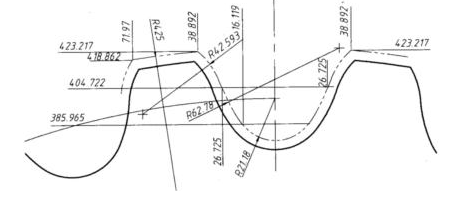
When milling roller sprockets with precision parts, the following process requirements shall generally be met: the diameter of the root circle and the pitch of the dividing circle shall be accurate; The axial circular runout of the sprocket and the radial circular runout of the tooth root circle are within the allowable range; The tooth shape is accurate, and the arc radius of the tooth groove and the surface roughness of the tooth surface meet the requirements of the drawing.
When the quantity is small, a specialized milling cutter designed according to the sprocket pitch, outer diameter of the roller or sleeve, and number of teeth can generally be used for milling. The milling method is basically the same as milling diameter cylindrical gears. Since roller chain transmission is a non conjugate meshing transmission with intermediate flexible parts in precision parts processing, its tooth profile requirements are not high, unlike gears, which have higher requirements for tooth profile curve. Therefore, if there is a lack of special sprocket milling cutter, milling can be carried out through milling cutter, and the obtained approximate tooth profile can also get better use effect in transmission.
Common Process Equipment for Assembly and Milling in Precision Parts Processing
Four Typical Chips Produced during Dongguan Turning and Milling Compound Processing
Related Article

Let us go over the foundations of the electroplating procedure. Electroplating involves several phases, and from pre-treatment to post-treatment there are several really significant ones.
The basic principle of surface treatment of precision parts in CNC machining

Audio panels, electronic cigarette shells, nameplateLOG, watch shells, etc. are among the CNC processing of high surface texture needs components.
CNC machining aluminum alloy parts high-quality surface texture process explained in detail

Metallic finishing, sometimes known as metallic finishing, is the process of using several techniques to change the surface of an object in order to improve appearance and performance, such as corrosion resistance, discoloration resistance, chemical resistance, abrasion resistance, and hardness, modify electrical conductivity, remove burrs, or apply a specific color to a machined part.
Metal CNC finishing surface treatment process and its working principle
