
How to handle the machining accuracy of large CNC machining centers
author: Hansheng Automation
2023-04-17
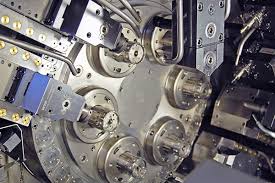
When the machining accuracy of large CNC machining centers is poor, the following three aspects should be analyzed and addressed.
(1) Poor machining accuracy of parts is usually due to improper adjustment of the feed dynamics between shafts during equipment adjustment, or due to changes in the transmission chains of each axis of the CNC machining center after wear (such as gaps between screws, pitch errors, axial motion, etc. during vertical machining).
(1) Poor machining accuracy of parts is usually due to improper adjustment of the feed dynamics between shafts during equipment adjustment, or due to changes in the transmission chains of each axis of the CNC machining center after wear (such as gaps between screws, pitch errors, axial motion, etc. during vertical machining).
It can be processed by adjusting and correcting the gap offset from the beginning. When the dynamic tracking error is too large and an alarm is issued, it is possible to check whether the speed of the servo motor is too high; Whether the orientation detection element is protruding; Whether the contact of the directional response cable connector protrudes; Whether the corresponding analog output latch and gain potentiometer are prominent; Whether the corresponding servo drive equipment is normal.
(2) Excessive adjustment of the motion of the CNC machining center leads to poor machining accuracy, which may be due to short acceleration and deceleration times, which may appropriately extend the speed change time; It is also possible for the connection between the servo motor and the screw to be loose or have poor rigidity, and the gain of the azimuth ring can be appropriately reduced.
(3) The roundness of the double axis connecting rod exceeds the tolerance range.
a. Axial deformation of a circle
This deformation may be caused by mechanical faults. The positioning accuracy of the shaft is poor, or the clearance of the lead screw is not properly compensated, resulting in roundness error when passing through the quadrant.
b. Oblique ellipse error (ellipse in 45 degree direction)
At this point, the bearing error value of each shaft should be checked first. If the error is too large, the azimuth loop gain can be adjusted to sweep. Then check whether the interface board of the rotary transformer or induction synchronizer is adjusted correctly, and then check whether the gap between the mechanical transmission pairs is too large and whether the gap compensation is appropriate.
Introduction to Dynamic and Static Optimization Design of Spindle Characteristics in CNC Machining
What determines the precision of small-scale CNC machining
Related Article

Let us go over the foundations of the electroplating procedure. Electroplating involves several phases, and from pre-treatment to post-treatment there are several really significant ones.
The basic principle of surface treatment of precision parts in CNC machining

Audio panels, electronic cigarette shells, nameplateLOG, watch shells, etc. are among the CNC processing of high surface texture needs components.
CNC machining aluminum alloy parts high-quality surface texture process explained in detail

Metallic finishing, sometimes known as metallic finishing, is the process of using several techniques to change the surface of an object in order to improve appearance and performance, such as corrosion resistance, discoloration resistance, chemical resistance, abrasion resistance, and hardness, modify electrical conductivity, remove burrs, or apply a specific color to a machined part.
Metal CNC finishing surface treatment process and its working principle
