
Five Points to Pay Attention to for Tool Radius Compensation in Precision Part Processing
author: Hansheng Automation
2023-05-17
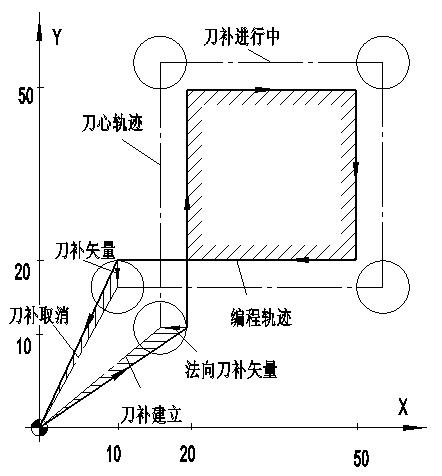
In the machining process of precision parts, it controls the trajectory of the tool center. For convenience, users always compile machining programs based on the contour of the parts. Therefore, in order to process the required part contour, the tool center must be offset by a tool radius value towards the inner side of the part: when processing the outer contour, the tool center must be offset by a tool radius value towards the outer side of the part. This CNC device can automatically generate the tool center trajectory in real-time through a program written based on the part contour and preset offset parameters, which is called the tool radius compensation function.
1. The establishment and cancellation of radius compensation mode is only valid in C0 or C01 movement command mode. Of course, some systems now support C02 and C03 modes, but to prevent errors, it is best not to use C02 and C03 commands in the radius compensation setting and cancellation segments.
2. To ensure the safety of the tool and workpiece during the establishment and cancellation of tool compensation, C01 motion mode is usually used to establish or cancel tool compensation. If using the C0 movement method to establish or cancel tool compensation, the programming method of first establishing tool compensation, then lowering and retracting the tool, and then canceling tool compensation should be adopted.
3. In order to facilitate coordinate calculation, tangent or normal cutting methods are used to establish or cancel tool compensation during precision part machining. When it is inconvenient to cut along the tangent or normal direction of the workpiece contour line, arc auxiliary program segments can be added according to the situation.
4. In order to prevent tool overcutting during the establishment and cancellation of radius compensation, it is best to have the starting and ending positions of the tool radius compensation establishment and cancellation program segments on the same side as the compensation direction.
5. In the tool compensation mode, it is generally not allowed to have more than two consecutive non compensated planar motion commands, otherwise the tool may also experience dangerous actions such as overfitting.
What turning tools are needed to process different threads for precision parts
Six Process Characteristics of Precision Parts Processing Plane
Related Article

Let us go over the foundations of the electroplating procedure. Electroplating involves several phases, and from pre-treatment to post-treatment there are several really significant ones.
The basic principle of surface treatment of precision parts in CNC machining

Audio panels, electronic cigarette shells, nameplateLOG, watch shells, etc. are among the CNC processing of high surface texture needs components.
CNC machining aluminum alloy parts high-quality surface texture process explained in detail

Metallic finishing, sometimes known as metallic finishing, is the process of using several techniques to change the surface of an object in order to improve appearance and performance, such as corrosion resistance, discoloration resistance, chemical resistance, abrasion resistance, and hardness, modify electrical conductivity, remove burrs, or apply a specific color to a machined part.
Metal CNC finishing surface treatment process and its working principle
