
Cutting processing
author: Hansheng Automation
2019-01-30
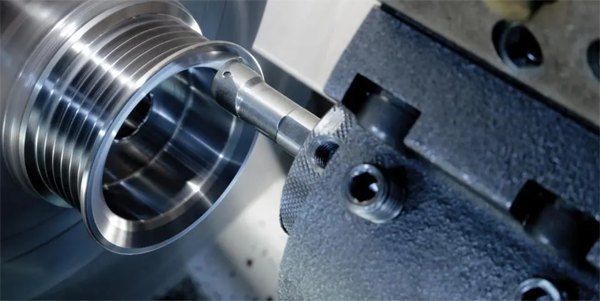
Increasing the cutting amount to improve the material removal rate is a basic way to improve cutting efficiency. The commonly used efficient cutting methods include high-speed cutting, strong cutting, plasma arc heating cutting, and vibration cutting.
1. High speed cutting
Generally, it refers to the cutting speed that can be achieved by using hard alloy cutting tools. Cutting with a grinding speed of over 45 meters per second is called high-speed grinding. The use of high-speed cutting (or grinding) can improve efficiency and reduce surface roughness. The cutting speed of high-speed turning ordinary steel with hard alloy cutting tools can reach 200 meters/minute; Up to 500m/min with ceramic cutter; The cutting speed of turning non-ferrous metals with diamond cutting tools can reach 900 meters/minute. The ultra high speed cutting speed tested in the laboratory can reach over 4000 meters/minute. Since the 1960s, the grinding speed has gradually increased from around 30 meters per second to 45, 60, 80, and even 100 meters per second; The grinding speed in the laboratory has reached 200 meters per second. High speed cutting (or grinding) requires machine tools to have a process system with high speed, high stiffness, high power, and good vibration resistance; It is required that the knife has reasonable geometric parameters and convenient fastening methods, as well as safe and reliable chip breaking methods.
2. Strong cutting
Refers to cutting with large feed or deep cutting, generally used for turning and grinding (see creep feed grinding). The main feature of strong turning is that in addition to the main cutting edge, the turning tool also has a secondary cutting edge parallel to the machined surface of the workpiece that participates in cutting at the same time. Therefore, the feed rate can be increased by several times or even more than ten times compared to general turning. On general machine tools, strong cutting can be carried out as long as the power is sufficient and the process system stiffness is good. Compared with high-speed cutting, strong cutting has lower cutting temperature, longer tool life, and higher cutting efficiency; The disadvantage is that the machined surface is relatively rough. During strong cutting, the radial cutting force is very large, so it is not suitable for processing slender workpieces.
Refers to cutting with large feed or deep cutting, generally used for turning and grinding (see creep feed grinding). The main feature of strong turning is that in addition to the main cutting edge, the turning tool also has a secondary cutting edge parallel to the machined surface of the workpiece that participates in cutting at the same time. Therefore, the feed rate can be increased by several times or even more than ten times compared to general turning. On general machine tools, strong cutting can be carried out as long as the power is sufficient and the process system stiffness is good. Compared with high-speed cutting, strong cutting has lower cutting temperature, longer tool life, and higher cutting efficiency; The disadvantage is that the machined surface is relatively rough. During strong cutting, the radial cutting force is very large, so it is not suitable for processing slender workpieces.
3. Plasma arc heating cutting
It is a cutting method that uses the high temperature of plasma arc to instantly heat the local cutting area of the workpiece to 800~900 ℃. Ceramic tools are often used, which are suitable for machining large pieces. During cutting, the heating intensity of the plasma arc should be adjusted based on the material, size, cutting speed, cutting depth, and feed rate of the workpiece. After appropriate adjustment, the temperature of the machined surface of the workpiece can be maintained below 150 ℃ without causing any metallographic changes. This method is suitable for machining hardened workpieces and cutting difficult to machine metal materials. The material removal rate can be increased by 2-20 times, and the cost can be reduced by 30-85%.
It is a cutting method that uses the high temperature of plasma arc to instantly heat the local cutting area of the workpiece to 800~900 ℃. Ceramic tools are often used, which are suitable for machining large pieces. During cutting, the heating intensity of the plasma arc should be adjusted based on the material, size, cutting speed, cutting depth, and feed rate of the workpiece. After appropriate adjustment, the temperature of the machined surface of the workpiece can be maintained below 150 ℃ without causing any metallographic changes. This method is suitable for machining hardened workpieces and cutting difficult to machine metal materials. The material removal rate can be increased by 2-20 times, and the cost can be reduced by 30-85%.
4. Vibration cutting
Adding low-frequency or high-frequency vibrations along the tool feed direction can improve cutting efficiency. Low frequency vibration cutting has excellent chip breaking effect, without the use of chip breaking devices, which increases the strength of the cutting edge and reduces the total power consumption by about 40% compared to ordinary cutting with chip breaking devices. High frequency vibration cutting, also known as ultrasonic vibration cutting, helps to reduce the friction between the tool and the workpiece, lower the cutting temperature, reduce the adhesive wear of the tool, thereby improving cutting efficiency and machining surface quality. The tool life can be increased by about 40%.
Adding low-frequency or high-frequency vibrations along the tool feed direction can improve cutting efficiency. Low frequency vibration cutting has excellent chip breaking effect, without the use of chip breaking devices, which increases the strength of the cutting edge and reduces the total power consumption by about 40% compared to ordinary cutting with chip breaking devices. High frequency vibration cutting, also known as ultrasonic vibration cutting, helps to reduce the friction between the tool and the workpiece, lower the cutting temperature, reduce the adhesive wear of the tool, thereby improving cutting efficiency and machining surface quality. The tool life can be increased by about 40%.
Prospects for the future market development trend of the motor industry?
What does the precision of internal and external circular grinding specifically refer to?
Related Article

In order to create new products that are constantly emerging on the market, we use different methods to process various materials.
What is Molding Processing? We will introduce some representative molding processing methods

In the context of vehicle electrification and intelligence, human-computer interaction with consumer experience and intelligent control as the core has become an important development theme of intelligent cockpits. The on-board display is at the core of the intelligent cockpit, benefiting from the continuous development of the Internet of Vehicles and smart cars, the on-board display will usher in new development opportunities.
Lighting up new opportunities for automotive electronics - all at the 2025 Guangzhou International Automotive Intelligent Cockpit and Vehicle Display Technology Event

The 2025 Asia International Power Semiconductor, Materials and Equipment Technology Exhibition will focus on "Focusing on Cutting-edge Technology Breakthroughs and Empowering Industrial Innovation and Integration". It will be held on November 20-22, 2025 at Guangzhou Poly World Trade Center Expo!
Focus on the power semiconductor industry - APSME 2025 Asia International Power Semiconductor, Materials and Equipment Technology Exhibition will be held in Guangzhou

Lexey's multi-axis bus stepper drivers – 2DM3/2CL3-EC (open/closed-loop) dual-axis series and 4DM3/4CL3-EC (open/closed-loop) four-axis series are innovative technologies designed to solve the above problems and help your equipment to achieve efficient upgrades.
"Three provinces" drive: Leisai multi-axis bus stepping, opening a new chapter in the miniaturization and upgrading of precision equipment