
What is Perforated Sheet Metal? Its characteristics, types and standards
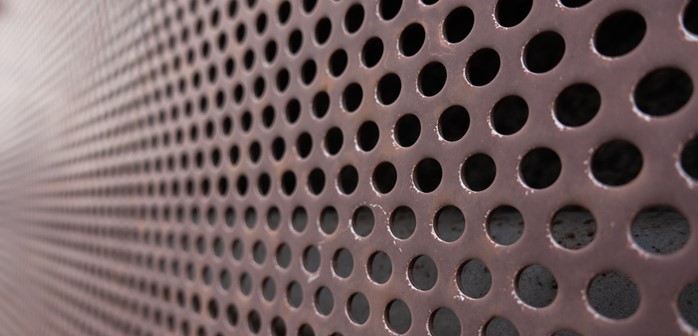
Perforated metal sheet is a type of metal sheet with many holes, which is suitable for various purposes such as home appliances, automobiles, buildings, and machinery. As an example, you can easily think of perforated metal plates that are neatly arranged in the outer round holes that correspond to the hot parts of the computer. However, the shape of the hole varies depending on the application.
This article will introduce the types, characteristics, standards, and use cases of punched metal sheets.
What is Perforated Sheet Metal?
Perforated sheet metal is a metal sheet that is processed by cutting holes in a mold. In addition to reducing weight, increasing air permeability, and achieving heat dissipation, the opening can also be used for sound insulation scenarios. In addition, text and images can be expressed through openings to enhance the sense of design.
The punched metal sheet is made by using the lower die support of the "stamping die" to position the metal plate, and then stamping it with the "punch". The processing time is shorter compared to laser processing. The dimensional accuracy of the holes is also very high, and the error is small. The use of universal tooling also reduces the initial cost.
Conversely, if you want to manufacture a perforated metal mesh with complex hole shapes, you can also use a special mold for processing.
The material of the perforated metal sheet
The main materials of perforated metal sheets include iron, steel, stainless steel, and aluminum, among others, but other materials can also be used for machining. Steel products are used for building decoration, stainless steel products are used for ventilation fan air inlets, aluminum products are used for household appliances heat vents, etc.
Perforated metal sheets can be used to expand the scope of use by changing the material, opening method, plate size, opening rate, etc.
Types of perforated metal sheets
Depending on the shape and arrangement of the holes, there are many types of perforated metal sheets. In addition, different materials of perforated metal sheets also have different characteristics. Here are the main types of perforated metal sheets.
- Shape and type of holes: Perforated metal sheets with "round holes" are the most common, and there are also perforated metal sheets with "square holes (square)", "rectangular holes (rectangular", "R corner rectangular holes", "long holes", etc. Others include "diamond-shaped holes" and "〇 ten" perforated metal sheets with alternating round holes and cross-shaped holes.
- Arrangement of holes: The most common arrangement is the "60° hounds", where holes are made along the vertices of an equilateral triangle. Other types include the "45° Chidori Pose", which is based on a right-angled isosceles triangle, and the "Juxtaposition", which is arranged in good positions both longitudinally and horizontally. There are also perforated metal plates such as "herringbone parallel patterns", "long-hole diagonal patterns", and "tortoiseshell patterns" that resemble tortoiseshells.
- Main steel plate materials: The materials of punched metal plates are mostly steel, stainless steel and aluminum. Stainless steel is often used in SUS304 and SUS430, and because it is not easy to rust, it can be used outdoors. Iron and steel include cold-rolled steel sheet SPCC, electro-galvanized steel sheet SECC, hot-dip galvanized steel sheet SGCC and pickled steel sheet SPHC, etc., which are relatively cheap and have good processing performance. Aluminum is light in weight, easy to process, easy to transfer heat, commonly used A1050, A1100, A5052, etc.
Standard for perforated sheet metal
There is no uniform standard for perforated metal sheets like JIS. The shape, size, spacing dimensions, etc., of the holes are all formulated according to the manufacturer's own standards. Even though the hole diameter and arrangement of the perforated metal sheets in the shape of a "round hole" look the same, the pitch size may vary depending on the manufacturer. There is no standard for the hole shape and spacing of perforated metal plates, but there are fixed specifications for each type of steel plate in terms of external dimensions. For example, the specifications of SUS304 materials are required in the JIS standard, such as 1000 × 2000 mm. Due to the large number of products in circulation on the market, punched metal sheets of the same size are sometimes produced. On the other hand, it is also possible to cut fixed-size perforated metal sheets to the size required by the customer. When sourcing perforated sheet metal, it is important to confirm the required specifications such as shape, arrangement, and size with the manufacturer to ensure consistency. However, if you want to cut to the specified size, you may cut to the position of the hole, and there will be sharp corners remaining, which poses a risk of cutting the user's safety. Therefore, it is also necessary to check the material specifications with the manufacturer and avoid holes in the cut-off part, such as partial white space.
Perforated metal sheets in the white style of the MISUMI frame are available.
Uses and use cases of punched metal sheets
The main use cases for stamped sheet metal are described below.
- Interior and exterior decoration materials: Perforated metal sheets can be used for the interior and exterior decoration of buildings, and it is difficult to notice if you don't look at them deliberately, such as perforated metal sheets with holes on apartments or apartment balconies as exterior decoration. Perforated metal sheets are used as components to secure fences, fences, and solar panels. In terms of interior decoration, ceilings, wall panels, partitions, lighting fixtures, chair backs, and various interior decorations are used.
- Automotive Parts: Many of the parts inside the car are made of perforated metal sheets. Such as air and oil filters, exhaust mufflers, speaker covers, etc. Functions that can be achieved by perforated metal sheets, such as heat dissipation, weight reduction, dust prevention, and sound insulation measures, are designed to suit each shape.
- Parts and components of household appliances: Some household appliances will use various styles of perforated metal plates for the exterior and interior parts. For example, many people immediately think of a cooktop ventilator filter. It is made of sheet metal and has small holes that prevent dust and garbage from adhering to the ventilation fan. Others such as furnace grilles, radiator grilles, motor covers, etc. are also made of perforated metal sheets.
- Sorter: Perforated sheet metal is also used as a mechanical component for sieving grains, seeds, minerals, etc. By adjusting the size of the holes, they can be divided into large particles, small particles, etc. For example, in order to sort the size of beans such as soybeans, the hole diameter of the perforated metal plate can be adjusted so that the soybeans and adzuki beans are separated. In addition, perforated metal sheets can also be used to screen coal, sand and gravel, etc.
- Plant Filter: A filter is a component installed in the pipes through which the fluid passes and is responsible for removing dirt and other debris, etc. Filters are used to remove impurities such as essential oils, milling and pulp. The hole shape and spacing of punched sheet metal must be designed with both pressure loss and the ability to remove impurities.
- Ancillary facilities of buildings: Perforated metal sheets can also be used for sound insulation and building insulation on construction sites. In addition, it can also be used for spray fans in tunnels, etc.
- Other: In environments such as data centers, perforated metal mesh is used as a cover plate to place server racks. While making it difficult to touch the inside, it improves ventilation and makes it easy to cool. Punched metal plates in the styles of round holes, long holes, and rectangular holes are more commonly used. Other design applications include monuments, signage, and graphic perforation, among others. Only make holes in the text part or image to make it more eye-catching. In turn, only the text part is not punched to highlight it.
Perforated metal sheets are made by making holes in metal sheets with pressure equipment, and are used not only in industrial products, but also in various fields such as construction and billboards. Standards such as JIS do not specify specific specifications, but each manufacturer has its own standards. It is also possible to customize the shape, spacing, etc. of the holes by creating special molds. Since the punched sheet metal that can be handled by different manufacturers has different materials, shapes, and spacings, it is important to integrate styles beforehand.
What is a Machining Center (MC)?
What is Die Casting? Features and precautions
Related Article


