
The demand for robots in the automotive industry is booming, with operating inventory reaching 1 million units
author: Hansheng Automation
2023-05-19
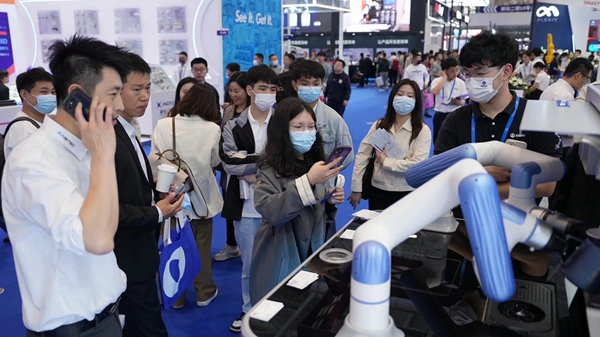
Recently, the International Robotics Association released a report showing that the number of robots operating in inventory in the global automotive industry has set a new record, reaching about 1 million units, accounting for about one-third of the total installed in all industries.
Among all industries, the robot density in the automotive industry is also the highest. In 2021, the robot density in the Korean automotive industry reached 2867 units per 10000 people, nearly three times the average level of the manufacturing industry; Germany ranks second with 1500 units, followed by the United States with 1457 units, followed by Japan with 1422 units per 10000 people.
China is the world's largest automobile manufacturing country, with a robot density of 772 units in the automotive industry, while the manufacturing robot density is 322 units. However, from the top few, it can be seen that there is still great room for improvement in the robots used in the automotive industry in China.
In recent years, the number of robots used in the automotive industry in China has also grown rapidly. In 2021, 61598 units were installed, while only 119405 units were installed globally that year, accounting for 52% of the market share. It is expected that they will catch up in the next few years.
The Application of Robots in Automotive Manufacturing
Automobile is a highly integrated product of modern industry, and its manufacturing process can be divided into four parts: stamping, welding, spraying, and final assembly, commonly known as the "four major processes" of automobile manufacturing.
As the name suggests, stamping is the process of pressing steel plates into the shape of the body shell, including various skeleton and covering parts; Welding is the process of connecting various components together to form the initial vehicle body; Spraying is the process of evenly covering the vehicle with paint, which not only reduces corrosion but also enhances aesthetics; The final assembly is to assemble various components into a complete car.
Although it is easy to say, the actual manufacturing process is very complex. A car has tens of thousands of bare parts, such as welding. Simply welding the entire body, usually there are thousands of welding points, and spraying not only needs to be evenly sprayed, but also has very high requirements for thickness. These processes are difficult to achieve with manpower, so they need to rely on robots. Nowadays, stamping, welding Robots have been widely used in the three stages of spraying. Due to the large number of parts in the final assembly, it is very difficult to fully automate. However, the proportion of robots used has been gradually increasing recently. For example, collaborative robots that can cooperate with humans are a very good choice.
The benefits of using robots to manufacture cars are beyond doubt. With the characteristics of high speed, high precision, and stability of robots, standardized processes designed are essential for industrial manufacturing. Moreover, the efficiency of robots operating 24 hours a day is completely incomparable to that of manual labor. Increasing the proportion of robot applications has always been a trend in the automotive manufacturing industry.
Nowadays, domestic and foreign automobile brands are striving to improve the automation rate of factories, and there have been nearly 100% smart factories like "black light factories". From raw materials to final products, all processing, transportation, and testing processes are completed in empty workshops, without human intervention. The factories are completely handed over to machines, and because they can turn off the lights for operation, they are named "black light factories".
In the operation of a "black light factory" displayed by SAIC General Motors, various industrial robots perform their respective tasks, including stamping, welding, spraying, and other processes. They work in an orderly and seamless manner, demonstrating amazing skills. In the final assembly workshop, industrial robots can also find parts corresponding to different car models and transport them to the production line, achieving mixed production of multiple car models, with an average of 1 complete vehicle offline every 76 seconds.
Opportunities brought by the development of new energy vehicles
The development speed of new energy vehicles in China is beyond imagination. Data shows that in 2022, the production and sales of new energy vehicles in China reached 7.058 million and 6.887 million, respectively, with year-on-year growth of 96.9% and 93.4%. The market share reached 25.6%, 12.1 percentage points higher than the previous year; In February of this year, the production and sales of new energy vehicles in China reached 552000 and 525000, respectively, with year-on-year growth of 48.8% and 55.9%, and a market share of 26.6%.
The transition from fuel powered vehicles to new energy vehicles is undoubtedly a huge opportunity for the robotics industry. After all, in this transformation process, not only is it a change in the power system, but also the entire production and manufacturing chain needs to be changed. Whether it is updating old production models or meeting emerging manufacturing needs, there will be a huge demand for industrial robots.
Marina Bill, President of the International Federation of Robotics, also stated that automated manufacturing has been effectively applied in the automotive industry. Nowadays, robots play a crucial role in driving the transformation of the automotive industry from internal combustion engines to electricity. Robot automation will help the automotive manufacturing industry establish long-term large-scale changes in processes and technologies.
Not only China, but also major countries around the world are increasing their investment in new energy vehicles. For example, the European Union has announced plans to end the sale of gasoline powered vehicles by 2035; The US government aims to achieve a 50% market share in electric vehicle sales by 2030, and all new cars sold in China must be "new energy" by 2035.
The accelerated development of new energy vehicles not only directly increases the demand for robots, but also indirectly expands the application of robots in other fields, the most obvious of which is the lithium battery industry. According to incomplete statistics, the planned production capacity of the entire lithium battery industry has exceeded 2TWh. Generally speaking, 50-70 robots are needed for 1GWh, which means at least 100000 robots are needed. In fact, New energy vehicles have become the main driving force for the growth of robot sales, and in terms of current penetration rate, there is still great room for development in the future.
Overseas markets continue to be positive, and companies that want to go global should pay attention to these!
The industrial robot enterprise that sold over 10000 units last year has been delisted!
Related Article

In order to create new products that are constantly emerging on the market, we use different methods to process various materials.
What is Molding Processing? We will introduce some representative molding processing methods

In the context of vehicle electrification and intelligence, human-computer interaction with consumer experience and intelligent control as the core has become an important development theme of intelligent cockpits. The on-board display is at the core of the intelligent cockpit, benefiting from the continuous development of the Internet of Vehicles and smart cars, the on-board display will usher in new development opportunities.
Lighting up new opportunities for automotive electronics - all at the 2025 Guangzhou International Automotive Intelligent Cockpit and Vehicle Display Technology Event

The 2025 Asia International Power Semiconductor, Materials and Equipment Technology Exhibition will focus on "Focusing on Cutting-edge Technology Breakthroughs and Empowering Industrial Innovation and Integration". It will be held on November 20-22, 2025 at Guangzhou Poly World Trade Center Expo!
Focus on the power semiconductor industry - APSME 2025 Asia International Power Semiconductor, Materials and Equipment Technology Exhibition will be held in Guangzhou

Lexey's multi-axis bus stepper drivers – 2DM3/2CL3-EC (open/closed-loop) dual-axis series and 4DM3/4CL3-EC (open/closed-loop) four-axis series are innovative technologies designed to solve the above problems and help your equipment to achieve efficient upgrades.
"Three provinces" drive: Leisai multi-axis bus stepping, opening a new chapter in the miniaturization and upgrading of precision equipment