
How to Reduce Surface Roughness When Using Two Hand Control Method for Precision Parts Processing
author: Hansheng Automation
2023-05-17
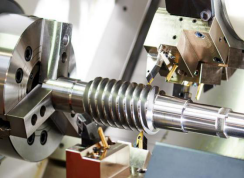
When using the two handed control method for precision parts machining and turning, uneven feed often leaves uneven marks on the surface of the workpiece. In order to meet the specified surface roughness requirements, after the workpiece is turned, it should be carefully trimmed with a coarse file and polished with a fine file, preferably polished with sandcloth.
When using a file on a lathe, in order to ensure safety, it is not allowed to use a file without a handle to avoid hand contact with the chuck. When filing, you should hold the handle with your left hand and hold the front end of the file with your right hand. The pressure should be uniform and consistent, and excessive force should not be used, otherwise it will affect the roundness of the workpiece. The filing allowance should not be too much, usually around 0.1mm, and the speed should not be too high.
After the workpiece is filed, there will be slight scratches on the surface, which can be removed by sanding. The abrasive cloth used on lathes is generally made of corundum sand particles. According to the thickness of the sand particles, commonly used sandcloth types are 00, 01, 1, 1.5, and 2. The smaller the number, the finer the particles. Number 00 is fine sandcloth, and number 2 is coarse sandcloth.
When polishing with sandcloth, the workpiece should be rotated at a higher speed and slowly moved back and forth on the workpiece using sandcloth. Finally, add a small amount of lubricating oil to the fine sandcloth to reduce surface roughness.
When polishing with abrasive cloth, it is not allowed to wrap the abrasive cloth around the workpiece and fingers of precision parts for polishing.
Five Methods for Machining Conical Surface of Precision Parts on Lathe
What turning tools are needed to process different threads for precision parts
Related Article

Let us go over the foundations of the electroplating procedure. Electroplating involves several phases, and from pre-treatment to post-treatment there are several really significant ones.
The basic principle of surface treatment of precision parts in CNC machining

Audio panels, electronic cigarette shells, nameplateLOG, watch shells, etc. are among the CNC processing of high surface texture needs components.
CNC machining aluminum alloy parts high-quality surface texture process explained in detail

Metallic finishing, sometimes known as metallic finishing, is the process of using several techniques to change the surface of an object in order to improve appearance and performance, such as corrosion resistance, discoloration resistance, chemical resistance, abrasion resistance, and hardness, modify electrical conductivity, remove burrs, or apply a specific color to a machined part.
Metal CNC finishing surface treatment process and its working principle
