
How many methods can you use to reduce friction errors in your turning and milling composite machining center?
author: Hansheng Automation
2023-05-15
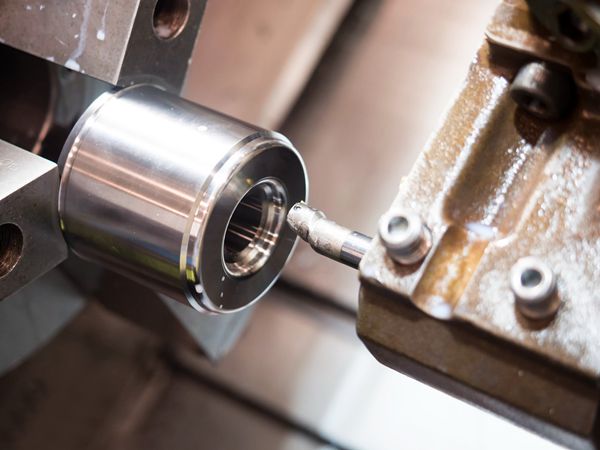
The turn-milling composite processing equipment includes machine components such as the bed, spindle, and feeding mechanism. Due to the high precision and productivity of CNC machine tools, compared with traditional ordinary machine tools, they should have better rigidity and vibration resistance, smaller relative motion friction coefficient, and smaller clearance between transmission components. It should be very small. The gearbox and transmission system should be easy to achieve automatic control.
How can precision turning and milling machines reduce friction errors? The turning and milling composite lathe adopts rolling guide rails, hydrostatic guide rails, aerostatic guide rails, or magnetic suspension guide rails to reduce system friction, reduce dynamic and static friction differences, and improve the dynamic performance of the feed system. However, using high-performance guides can greatly increase the cost of the machine.
The CNC lathe has improved the rigidity of the position loop, speed loop, and current loop of the servo drive system. When friction error occurs, the small error signal can be adjusted to the motor driving current in a timely and appropriate manner. However, high stiffness can easily cause system oscillations. Reducing the control cycle of each control circuit of the servo driver is also beneficial for improving the response speed of the system. However, reducing control cycles requires CNC equipment with higher hardware performance.
The CNC device of precision turning and milling composite machine tools will occasionally read the backlash value of each axis, compensate and correct the coordinate displacement command value, and accurately position the lathe in the required position according to requirements, thus eliminating or reducing the reverse deviation of the processed parts. The impact of accuracy.
For CNC lathes with semi closed-loop servo systems, the positioning accuracy and repeated positioning accuracy of the lathe are affected by reverse deviation, which in turn affects the machining accuracy of the processed parts. For the error in this situation, compensation methods can be used to compensate for the reverse deviation and reduce the accuracy error of the processed parts. Nowadays, many CNC lathes in China's mechanical processing industry have positioning accuracy exceeding 0.02mm. This type of lathe generally does not have a compensation function. In some cases, the single example of turning milling composite processing can be programmed to achieve meta positioning, with obvious backlash.
Analysis of the Causes of Tool Collision Failure in the Turning and Milling Composite Machining Center
Introduction to CNC machining programming operation process
Related Article

Let us go over the foundations of the electroplating procedure. Electroplating involves several phases, and from pre-treatment to post-treatment there are several really significant ones.
The basic principle of surface treatment of precision parts in CNC machining

Audio panels, electronic cigarette shells, nameplateLOG, watch shells, etc. are among the CNC processing of high surface texture needs components.
CNC machining aluminum alloy parts high-quality surface texture process explained in detail

Metallic finishing, sometimes known as metallic finishing, is the process of using several techniques to change the surface of an object in order to improve appearance and performance, such as corrosion resistance, discoloration resistance, chemical resistance, abrasion resistance, and hardness, modify electrical conductivity, remove burrs, or apply a specific color to a machined part.
Metal CNC finishing surface treatment process and its working principle
