
Why are there tool marks on the surface of CNC machining plants during CNC machining
author: Hansheng Automation
2022-09-13
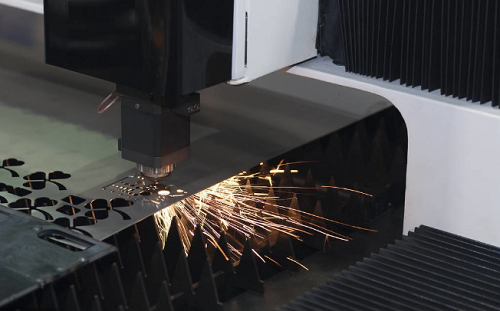
CNC machining plants often encounter a problem when machining product parts or molds with CNC, which is that when machining large flat surfaces, flying knives will leave contact marks when moving back and forth. This not only looks unattractive, but also affects quality and size if the steps are too large.
Normally, we can see with the naked eye if it is above 0.003mm. If it exceeds 0.005mm, it is obvious to touch it directly. Products with strict appearance requirements require polishing treatment, which increases a lot of workload. So what exactly is the cause?
A friend said that the new machine tool I bought, the table support table, and the verticality inspection of the spindle cone hole are all within reasonable tolerances, but there are still processing problems. Because traditional machining centers on the market are already very dilapidated, many small factories do not undergo strict testing to directly pull out and sell machine tools, resulting in many products made by new machine tools having tool lines. The direct reason for this problem is that the verticality of the spindle is not enough, and there is no careful inspection after assembly.
The simplest detection method is to use a 100% suction on the end face of the spindle cone hole, slowly rotate the spindle, and draw a circle with a larger diameter as much as possible. This way, the deviation in the XY direction of the workbench can be seen. Normally, within 0.02mm is reasonable, and the processing effect is also better. If this tolerance is not achieved, the spindle can only be removed and the verticality of the spindle can be adjusted.
What are the factors that affect efficiency during the machining of CNC precision automatic lathe
How to improve the quality and efficiency of five axis machining
Related Article

Let us go over the foundations of the electroplating procedure. Electroplating involves several phases, and from pre-treatment to post-treatment there are several really significant ones.
The basic principle of surface treatment of precision parts in CNC machining

Audio panels, electronic cigarette shells, nameplateLOG, watch shells, etc. are among the CNC processing of high surface texture needs components.
CNC machining aluminum alloy parts high-quality surface texture process explained in detail

Metallic finishing, sometimes known as metallic finishing, is the process of using several techniques to change the surface of an object in order to improve appearance and performance, such as corrosion resistance, discoloration resistance, chemical resistance, abrasion resistance, and hardness, modify electrical conductivity, remove burrs, or apply a specific color to a machined part.
Metal CNC finishing surface treatment process and its working principle
