
What is End Face Milling in Precision Parts Processing
author: Hansheng Automation
2023-05-16
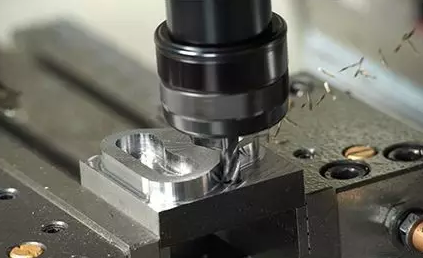
In the field of precision parts processing, end face milling refers to milling with the end face teeth of a milling cutter. When milling a plane, the tool tips distributed on the end face of the milling cutter are used to form a plane. The flat surface milled by the method of end face washing also has a series of knife lines, and the thickness of the knife lines (i.e. the size of the surface roughness value) is also related to many factors such as the feed speed of the workpiece and the speed of the milling cutter.
In the process of precision parts processing, the method of end face milling is used to mill out a plane, and the flatness is mainly determined by the perpendicularity of the milling machine spindle axis and the feed direction. If the spindle is perpendicular to the feed direction, the trajectory of the tool tip rotation is a circular ring parallel to the feed direction, which cuts a plane. In fact, the tip of the milling cutter will mill out a mesh like pattern on the surface of the workpiece. If the spindle of the milling machine is not perpendicular to the feed direction, it is equivalent to using an inclined ring to cut a concave surface on the workpiece surface. At this point, the milling cutter tip will mill out a unidirectional arc pattern on the surface of the workpiece.
The Composition System and Structural Characteristics of Three Coordinate Measuring Machines in Precision Parts Processing
Specification for positioning methods and wear patterns of positioning components in precision parts processing
Related Article

Let us go over the foundations of the electroplating procedure. Electroplating involves several phases, and from pre-treatment to post-treatment there are several really significant ones.
The basic principle of surface treatment of precision parts in CNC machining

Audio panels, electronic cigarette shells, nameplateLOG, watch shells, etc. are among the CNC processing of high surface texture needs components.
CNC machining aluminum alloy parts high-quality surface texture process explained in detail

Metallic finishing, sometimes known as metallic finishing, is the process of using several techniques to change the surface of an object in order to improve appearance and performance, such as corrosion resistance, discoloration resistance, chemical resistance, abrasion resistance, and hardness, modify electrical conductivity, remove burrs, or apply a specific color to a machined part.
Metal CNC finishing surface treatment process and its working principle
