
What is CNC milling machining

The initial step of the CNC milling process is to place the workpiece inside the CNC machine's holding mechanism. Next, the spindle is equipped with a milling tool. The software can be used to select end milling or horizontal milling for machining. The operator initiates the program and the milling process begins.
The instructions provided instruct the workpiece to move, rotate, and position for the machining tool to work. Feed by rotating tools, workpieces, or combinations.
The first step of milling involves making a series of tiny cuts to get close to the desired shape. Subsequently, the tool makes multiple passes on the workpiece to maintain the accuracy of each feature. For complex shapes, the tool moves multiple times on the workpiece, and sometimes multiple tool setups may be required.
Depending on the type of CNC machine, the milling cutter can be along 3, 4, 5 or 6 axes. It can create many shapes, holes, grooves, slots, and other features. According to the CAD design, CNC milling is completed by moving the tool along each axis; X and Y represent horizontal movement, Z represents vertical movement, and W represents diagonal movement.
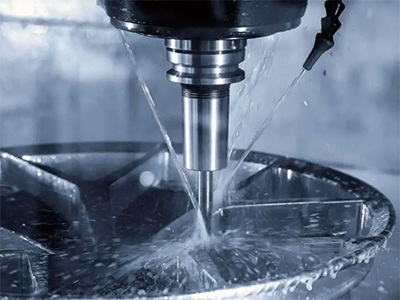
The type of milling process
The versatility of CNC milling makes it suitable for mass production, custom parts, and prototyping. There are four common categories of milling operations.
1. Face milling
It involves cutting a flat surface perpendicular to the cutting axis. The cutting teeth have a variety of special purposes and are located on and around the tool face. Whether milled vertically or horizontally, it produces a clean surface finish.
2. General milling
Face milling is performed by making the tool axis parallel to the surface of the workpiece. For normal milling, the workpiece needs to be mounted parallel to the milling machine table.
Narrow cutters are used for deep cuts in face milling, whereas wide cutters are used for wide surfaces. Cutting tools The coarse pitch cutter is first set at a slow cutting speed and a fast feed rate to obtain an approximate geometry. This is followed by high cutting speeds and slow feeds to precisely shape the material.
3. Angle milling
Angular milling refers to the machining of a flat surface where the tool forms an angle to the surface, such as 45°, 50°, 55°, or 60° is the typical angle. Angular milling is the best way to create angular surfaces, grooves, and contours chamfers. During machining, the side cutter is used to roughen the grooves, and the corner edges and base are finished with the angle cutter.
4. Forming milling
Shape milling is used to mill uneven surfaces, such as curved planes. Due to profile milling, multiple complex parts must be made into convex, concave, hemispherical, or other challenging shapes.
What you need to know about CNC aluminum machining
How the turntable indexer works
Related Article


