
What are the milling classification steps for large five axis machining centers
author: Hansheng Automation
2023-05-03
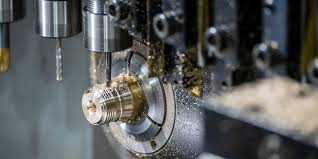
The milling of a large five axis machining center refers to the process of using rotating multi blade cutting tools to cut the workpiece in order to produce the finished product. It is currently one of the most efficient machining methods and is more accurate than mold casting and other methods.
At present, the application machines for milling include vertical milling machines, horizontal milling machines, and large gantry milling machines used for the production of large workpieces. Milling machines not only include ordinary mechanical machines, but also high-performance and highly automated CNC machines. Their common feature is the use of rotating milling cutters as cutting tools for machining.
The milling tool of the five axis machining center must rotate during operation, move the workpiece (which can also be fixed), and the rotating tool must also move simultaneously to achieve the effect of five axis linkage machining.
So, why should the milling of a five axis machining center be divided into rough milling, semi precision milling, and precision milling?
Firstly, in workpiece processing, the role of rough milling and semi precision milling is an irreplaceable step.
Secondly, the forging and casting process makes it impossible for the blank to directly control the precision milling allowance of the workpiece, and it is not possible to meet the process requirements with one milling, at least requiring another pre milling.
Then, rough milling removes most of the blank allowance, semi precision milling can control the allowance for precision milling, and precision milling completes the final size control and surface finish, all three of which are indispensable.
What is the maintenance of parts in the five axis machining center factory
What are the commonly used equipment for precision parts processing
Related Article

Let us go over the foundations of the electroplating procedure. Electroplating involves several phases, and from pre-treatment to post-treatment there are several really significant ones.
The basic principle of surface treatment of precision parts in CNC machining

Audio panels, electronic cigarette shells, nameplateLOG, watch shells, etc. are among the CNC processing of high surface texture needs components.
CNC machining aluminum alloy parts high-quality surface texture process explained in detail

Metallic finishing, sometimes known as metallic finishing, is the process of using several techniques to change the surface of an object in order to improve appearance and performance, such as corrosion resistance, discoloration resistance, chemical resistance, abrasion resistance, and hardness, modify electrical conductivity, remove burrs, or apply a specific color to a machined part.
Metal CNC finishing surface treatment process and its working principle
