
What are the components of automation equipment
author: Hansheng Automation
2023-05-20
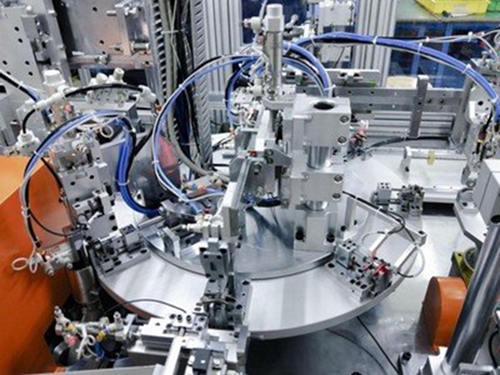
What is an automatic assembly machine? Generally speaking, assembly refers to the process of combining several components of a product through tight fitting, buckles, threaded connections, bonding, riveting, welding, etc. to obtain a finished product (semi-finished product) that meets predetermined dimensional accuracy and functionality.
The assembly achieved by manually handling (touching, organizing, grasping, moving, placing, applying force, etc.) each component can only be strictly referred to as manual assembly. Assembly that does not require manual handling (such as touching, organizing, grasping, moving, placing, etc.) of components can be called automatic assembly. The one between the two is semi-automatic assembly.
Composition of automatic assembly machine
1. Directional arrangement, transportation, and escape system of components
Arrange the disorderly components in a spatial orientation that is easy for the machine to automatically handle, and then smoothly transport them to the subsequent escape mechanism, preparing for the subsequent grasping of the robotic arm.
2. Grasping displacement placement mechanism
Grasp or vacuum the parts (components) that have been fixed by the escape mechanism, and then move them to another position (usually the assembly work position).
3. Assembly work mechanism
Refers to the mechanism used to complete the main action of assembly work, such as pressing, clamping, screwing, clamping, bonding, welding, riveting, bonding, and welding the workpiece onto the previous component.
4. Testing agency
Used to inspect the previously assembled components or machine's previous work results, such as missing parts inspection, size inspection, defect inspection, functional inspection, and material cleaning inspection.
5. Extraction mechanism of workpiece
A mechanism used to classify and remove assembled qualified and unqualified parts from the machine.
Hansheng Automation is engaged in customizing components for automated packaging machines. Mechanical parts are mostly made of steel, and frames are generally made of cast iron. In theory, machining and cutting of parts is sufficient, but now it should be done after forging and then precision machining. This type of part has better strength than cutting.
The processed parts cannot become finished products, and the most critical step is the final heat treatment program. Including heat treatment and surface heat treatment of the entire part.
Most mechanical parts have national standards, and standard parts should be chosen as much as possible during design. They are easy to find in the market and do not require all factory customization. Customizing non-standard parts is definitely not cheap. Of course, if it's a robot or something, it must be customized, and the material is not ordinary steel.
How can aluminum parts be milled without tool marks
Why are there still parts processing in molds now
Related Article

Let us go over the foundations of the electroplating procedure. Electroplating involves several phases, and from pre-treatment to post-treatment there are several really significant ones.
The basic principle of surface treatment of precision parts in CNC machining

Audio panels, electronic cigarette shells, nameplateLOG, watch shells, etc. are among the CNC processing of high surface texture needs components.
CNC machining aluminum alloy parts high-quality surface texture process explained in detail

Metallic finishing, sometimes known as metallic finishing, is the process of using several techniques to change the surface of an object in order to improve appearance and performance, such as corrosion resistance, discoloration resistance, chemical resistance, abrasion resistance, and hardness, modify electrical conductivity, remove burrs, or apply a specific color to a machined part.
Metal CNC finishing surface treatment process and its working principle
