
What are the characteristics of the machining design of the CNC precision automatic lathe
author: Hansheng Automation
2022-10-10
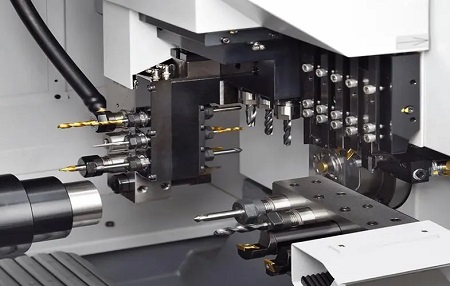
Due to its different structure from traditional CNC lathes, the machining efficiency and accuracy of the CNC precision automatic lathe are higher than those of CNC lathes. The CNC precision automatic lathe adopts a dual axis arrangement of cutting tools, which greatly saves processing cycle time. By shortening the tool exchange time between the tool arrangement and the opposite tool table, it achieves the functions of multiple tool table overlap and effective axis movement overlap of thread chips. The direct spindle indexing function during secondary processing shortens the actual idle travel time.
In the machining process of the clamping part between the spindle and the workpiece, the chip cutting tool has always played a very important role, providing a strong guarantee for constant machining accuracy. From the perspective of the centrifuge market, 38mm is its maximum machining diameter, which gives the centrifuge a significant advantage in the precision shaft machining market.
This series of machine tools can also be equipped with automatic feeding devices to achieve fully automated production of a single machine tool, reducing labor costs and defective products in the production process. It can be used to produce large quantities of precision shaft parts.
What are the requirements for the working environment of a five axis machining center factory
What are the requirements for the materials used in precision parts processing
Related Article

Let us go over the foundations of the electroplating procedure. Electroplating involves several phases, and from pre-treatment to post-treatment there are several really significant ones.
The basic principle of surface treatment of precision parts in CNC machining

Audio panels, electronic cigarette shells, nameplateLOG, watch shells, etc. are among the CNC processing of high surface texture needs components.
CNC machining aluminum alloy parts high-quality surface texture process explained in detail

Metallic finishing, sometimes known as metallic finishing, is the process of using several techniques to change the surface of an object in order to improve appearance and performance, such as corrosion resistance, discoloration resistance, chemical resistance, abrasion resistance, and hardness, modify electrical conductivity, remove burrs, or apply a specific color to a machined part.
Metal CNC finishing surface treatment process and its working principle
