
What are the characteristics of Dongguan turning and milling composite processing
author: Hansheng Automation
2023-05-17
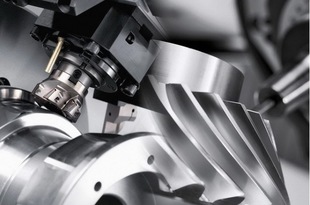
Dongguan turning-milling composite processing is the same as all other processing methods, and not all parts are suitable for car milling processing. Only when certain conditions are met can their processing characteristics be equally utilized. As an advanced metal cutting method, its main characteristics are:
(1) Turning and milling is intermittent cutting, which can obtain shorter chips regardless of the material being processed, making it suitable for processing parts of materials that are not easily chip removed.
(2) Turning and milling is extremely easy to achieve high-speed cutting, and the cutting force can be reduced by 30% compared to traditional cutting. This means that the radial force causing workpiece deformation has significantly decreased, which is conducive to improving the current accuracy of thin-walled and slender parts.
(3) Due to the fact that the cutting speed is composed of the rotational speed of the workpiece and the tool, high-speed cutting can be achieved without the need for the workpiece to tell the rotation, which is very beneficial for processing large workpieces, especially large forgings.
(4) The rotational speed of the workpiece is relatively low, and there is almost no deformation caused by centrifugal force when processing thin-walled parts.
(5) Using CNC turning and milling centers, workpieces that require different methods such as using vehicles, milling, drilling, and boring can be clamped in one operation. No need to replace the machine tool, greatly reducing the production cycle and preventing repeated clamping errors. Dongguan turning and milling composite machining is suitable for parts with complex shapes that require multiple clamping operations.
(6) The multi edge cutting process is smooth and the tool wear is small, which is very beneficial to the processing of new difficult to machine materials and large rotary body blanks.
(7) Heavy loads such as large rollers, generator rotors, large cast pipes, and crankshafts.
(8) Workpieces that require different processing methods such as using turning, milling, drilling, and boring.
Structural characteristics of staggered tooth three sided milling cutters in precision parts machining
What are the characteristics of centralized and dispersed machining processes in Dongguan's turn-milling composite processing
Related Article

Let us go over the foundations of the electroplating procedure. Electroplating involves several phases, and from pre-treatment to post-treatment there are several really significant ones.
The basic principle of surface treatment of precision parts in CNC machining

Audio panels, electronic cigarette shells, nameplateLOG, watch shells, etc. are among the CNC processing of high surface texture needs components.
CNC machining aluminum alloy parts high-quality surface texture process explained in detail

Metallic finishing, sometimes known as metallic finishing, is the process of using several techniques to change the surface of an object in order to improve appearance and performance, such as corrosion resistance, discoloration resistance, chemical resistance, abrasion resistance, and hardness, modify electrical conductivity, remove burrs, or apply a specific color to a machined part.
Metal CNC finishing surface treatment process and its working principle
