
What are the advantages and disadvantages of a horizontal five axis machining center
author: Hansheng Automation
2022-12-16
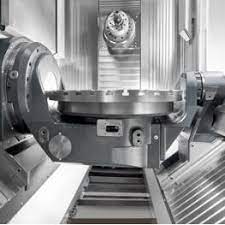
There are also two ways to rotate the axis of a horizontal five axis machining center. One is to swing the horizontal spindle as a rotating axis, and then add a rotating axis of the workbench. The vertical and horizontal conversion of the spindle is combined with the indexing of the workbench to achieve pentahedral machining of the workpiece. What are the advantages and disadvantages of a horizontal five axis machining center?
Disadvantages: The spindle has poor rigidity, but it does not perform linkage, making it suitable for different processing requirements of four axis machining centers with vertical and horizontal conversion.
Advantages: Easy and flexible processing, simple replacement of vertical or horizontal spindle, low manufacturing cost, and very practical.
The other type is the traditional workbench rotation axis, which is set on the bed and has a general working range of+20 degrees to -100 degrees for the A-axis of the workbench. There is also a rotary table B-axis in the middle of the workbench, which can rotate 360 degrees in both directions.
Disadvantages: The workbench is limited, the rotating shaft structure is relatively complex, and the price is also expensive.
Advantages: The rotary shaft can also be equipped with a circular grating ruler feedback, with a indexing accuracy of several seconds, commonly used for machining complex surfaces of large impellers.
What are the factors that affect the efficiency of plane milling in large CNC machining centers
What is the necessity of equipping the chip removal machine for large CNC machining centers
Related Article

Let us go over the foundations of the electroplating procedure. Electroplating involves several phases, and from pre-treatment to post-treatment there are several really significant ones.
The basic principle of surface treatment of precision parts in CNC machining

Audio panels, electronic cigarette shells, nameplateLOG, watch shells, etc. are among the CNC processing of high surface texture needs components.
CNC machining aluminum alloy parts high-quality surface texture process explained in detail

Metallic finishing, sometimes known as metallic finishing, is the process of using several techniques to change the surface of an object in order to improve appearance and performance, such as corrosion resistance, discoloration resistance, chemical resistance, abrasion resistance, and hardness, modify electrical conductivity, remove burrs, or apply a specific color to a machined part.
Metal CNC finishing surface treatment process and its working principle
