
Washing and Machining of Worms and Turbines in Precision Parts Processing
author: Hansheng Automation
2023-05-15
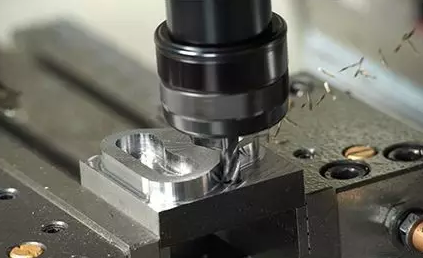
In the processing of precision parts, it is important to focus on mastering the calculation methods of milling worm and turbine related parameters, and be able to milling worm according to process requirements, and use various methods to milling turbine. The difficulties include the modification of milling machines, the calculation of worm gear and worm parameters, the calculation of generative motion during the milling process, and the inspection, adjustment, and quality analysis during the milling process.
Precision machining of worms and turbines is a mechanism used to transmit motion and power between two axes that are perpendicular but not intersecting in space. Worm pairs are often used for speed reduction mechanisms, and precision worm pairs can act on indexing mechanisms. Ordinary cylindrical worm can be divided into Archimedes helicoid worm [or axial straight profile worm], involute helicoid worm and extended involute helicoid worm according to the form of its tooth surface helicoid. Among them, Archimedes helicoid worm is widely used because of its easy processing. In actual production, worms and turbines with low accuracy and a small quantity can be milled on a universal milling machine.
Measurement methods in precision parts machining and milling
The Development Trend of New Tools in Precision Parts Processing
Related Article

Let us go over the foundations of the electroplating procedure. Electroplating involves several phases, and from pre-treatment to post-treatment there are several really significant ones.
The basic principle of surface treatment of precision parts in CNC machining

Audio panels, electronic cigarette shells, nameplateLOG, watch shells, etc. are among the CNC processing of high surface texture needs components.
CNC machining aluminum alloy parts high-quality surface texture process explained in detail

Metallic finishing, sometimes known as metallic finishing, is the process of using several techniques to change the surface of an object in order to improve appearance and performance, such as corrosion resistance, discoloration resistance, chemical resistance, abrasion resistance, and hardness, modify electrical conductivity, remove burrs, or apply a specific color to a machined part.
Metal CNC finishing surface treatment process and its working principle
