
Typical Overview of High Speed Precision Stamping Production Technology
author: Hansheng Automation
2023-05-10
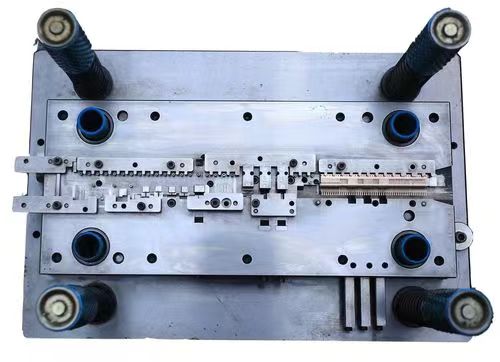
High speed precision stamping technology involves many fields such as machinery, electronics, materials, optics, computers, precision testing, information networks, and management technology, and is a multidisciplinary system engineering.
Characteristics and Application Fields of High Speed Precision Stamping Technology
High speed precision stamping technology is an advanced manufacturing technology in modern stamping production, which integrates high-tech technologies such as high-speed precision press technology, high-precision stamping die technology, high-quality product material technology, intelligent control technology, and green integration. The application of high-speed precision stamping technology for mass production of products has the characteristics of high production efficiency, high quality, high consistency, energy conservation, labor saving, cost reduction, and ensuring safe production. Therefore, it has been increasingly valued by various industrial production departments of the national economy. Currently, modern advanced manufacturing technology is a research and development topic for countries around the world, especially in today's highly developed market economy, where it holds a very important position.
Mold expert Luo Baihui stated that high-speed precision stamping mold technology is mainly based on the use of sheet metal processing products, consisting of three basic elements: high-speed press equipment, precision stamping molds, and high-quality coil materials. It is coordinated and connected in the uncoiling device, leveling device, feeding device, material lubrication device, output device, processing device, and receiving device of automated peripheral equipment, A stamping automation production line that is combined according to the stamping process flow.
Stamping automation can not only significantly improve labor productivity, improve labor conditions, and reduce costs, but also effectively ensure personal safety in stamping production, fundamentally changing the appearance of stamping production. Therefore, it is widely used in the fields of electronics, communication, automobiles, machinery, military industry, light industry, electrical machinery, instruments, medical equipment, automation equipment, and home appliance manufacturing. The application in the manufacturing of products such as rail transit, aerospace, and new energy is also becoming increasingly widespread.
Application of High Speed Press Technology
With the rapid development of product technology such as electronic communication, electrical appliances, automobiles, and home appliances, the demand for precision stamping parts is increasing, and the technical requirements are also increasing. Moreover, the application range is becoming more and more widespread. Therefore, in mass production and ultra mass production, ordinary press machines can no longer meet the production and technical requirements. The use of high-speed precision presses for high-speed, automated, and continuous stamping is an effective way to improve stamping productivity. Due to the fact that the slider stroke per minute of high-speed precision presses is more than 5 times higher than that of ordinary presses with similar tonnage, high-speed precision presses not only have high stamping accuracy, good surface quality, but also long mold service life.
In recent years, stamping technology has continuously developed towards high-speed, precision, and intelligence, promoting the development momentum of high-speed press machines. As a result, many high-speed precision press machines and ultra high-speed precision press machines have emerged, such as small tonnage high-speed precision press machines developed by German companies such as Raster, American company Minster, Swiss company Breeder, German company Schuler, Japanese company Nengrate and Electric Production, etc, The slider stroke times can reach 2000 times/minute, 3000 times/minute, and 4000 times/minute respectively. Under load conditions, it can also meet the special level accuracy requirements of its standard. This marks the development of high-speed precision press technology to a stage of ultra high speed and ultra precision technology.
Some foreign companies classify small tonnage high-speed precision presses into four speed levels based on the number of slider strokes: constant speed? Q250 times/minute, sub highway?? 250-400 times/minute, high-speed?? 400~1000 times/minute, ultra fast? R1000 times/minute. The slider stroke frequency of large tonnage high-speed precision press is relatively low. For example, for a 300 ton large-scale high-speed precision press, the slider stroke range is only around 160-400 times/minute, while for a 100 ton fin specialized high-speed precision press, the slider stroke range is generally around 150-250 times/minute.
Due to the variation of stamping speed with various factors such as press tonnage, slider stroke length and frequency, product process structure and material process performance, automatic feeding speed and accuracy, it is difficult to use simple numbers as boundaries for dividing different levels. Luo Baihui stated that currently, there is still no clear definition of the speed range of high-speed precision press internationally, High speed precision stamping is commonly referred to as high-speed precision stamping, where the stamping speed is 5-10 times higher than that of a regular press. From the application situation of high-speed precision presses in most Chinese enterprises, it can be seen that the average stroke speed of the lowest and highest strokes of the slider, or a stroke speed greater than 10-20% of the average, is a more reasonable and meaningful reference standard. Because the maximum stroke of the high-speed precision press slider generally refers to the number of unloaded strokes. When the number of strokes reaches a certain value, the imbalance phenomenon of the press during operation significantly increases, and the dynamic change of the lower dead center of the slider is also significant. This requires solving a series of technical problems such as coil quality, feeding speed, mold performance and life, equipment strength, stiffness and accuracy, automatic monitoring and stability of faults, vibration and noise, and lubrication and cooling systems. Therefore, the punching speed in the application of high-speed precision presses is crucial.
Types and Technical Characteristics of High Speed Precision Stamping Parts
High speed precision stamping parts can be divided into electronic parts, IC integrated circuit lead frames, motor iron cores, electrical iron cores, heat exchanger fins, automotive parts, home appliance parts, and other types according to industry, usage, and process characteristics. The parts mainly include connecting devices, connectors, brush parts, electrical terminals, elastic parts, etc.
The IC integrated circuit lead frame mainly includes discrete device lead frames and integrated circuit lead frames. The motor core mainly includes single-phase series excitation motor core, single-phase household motor core, single-phase shaded pole motor core, permanent magnet DC motor core, industrial motor core, plastic sealed stator core, etc. The electrical core mainly includes E-shaped transformer core, EI shaped transformer core, I-shaped transformer core, and other transformer iron chips. The fins of heat exchangers mainly include industrial heat exchanger fins, household heat exchanger fins, automotive heat exchanger fins, etc. Automotive components mainly include structural components and functional components. Home appliance parts mainly include household electrical parts, such as color tube electronic gun parts, as well as small household appliance parts, various structural and functional parts, etc. Other types of parts mainly include instrument and meter parts, IT parts, acoustic and camera parts, modern office parts, and hardware parts.
The technology of high-speed precision stamping parts has the characteristics of multiple varieties, diverse materials, thin plate rolling, large automated production batches, high precision, complex shapes, high technical content, and added value.
Overview of Motor Iron Core Production Technology
The iron core is an important component of motor products, usually made of 0.35mm and 0.5mm thick silicon steel sheets. In all stages of motor production, the production of iron core punching is crucial. At present, China's high-speed precision stamping iron chips and iron core automatic lamination riveting, iron core three row with twisted groove lamination riveting, iron core with twisted groove and rotary lamination riveting, iron core double rotary lamination riveting, iron core double row large rotary lamination riveting, large outer rotor iron core with twisted groove lamination riveting, stator iron core semi circular combination lamination riveting, stator iron core multi block combination lamination riveting The high-speed precision stamping production technology such as the combination of long and straight stator core coil and circular lamination riveting is no inferior to international advanced technology.
A typical overview of high-speed precision stamping production technology for iron core three column twisted groove laminated riveting products is that the iron core material is 50W470 silicon steel sheet, with a thickness of 0.5mm and a width of 307.5mm. The high-speed operation of the belt material is integrated with an uncoiling device, an S-type leveling device, a feeding device, a material lubrication device, a high-speed precision press, a large precision progressive die, and automatic stamping of guide nail holes, rotor plate stacking and riveting process holes, rotor plate marking holes, rotor plate measuring holes, rotor plate groove shapes, rotor plate step holes, rotor plate stacking and riveting points, rotor plate inner holes, rotor plate material stacking and riveting and twisting grooves, stator plate notches The cross continuous stamping of multiple workstations and processes, such as stator marking holes, stator measuring holes, stator slot shapes, stator lamination riveting points, stator inner holes, and stator blanking and riveting, completes three sets of stator and rotor iron core products in one go. The automatic riveting thickness of the iron core is 105mm, and the outer diameter of the stator iron core is 110.52? 0.02mm, outer diameter 55.1? 0.01/0.02mm。 The products are produced on a large high-speed precision press with a capacity of 300 tons, and the punching speed changes from 280 to 320 times/minute. The iron core products are automatically output during the stamping process.
Overview of production technology for heat exchanger fins
Fins are the main components of air conditioning products, usually made of 0.105mm thick aluminum foil. Luo Baihui pointed out that in recent years, China has made significant improvements in the production technology of high-speed stamping heat exchanger fins. For example, high-speed precision stamping production technologies such as household air conditioning heat exchanger fins, automotive air conditioning heat exchanger fins, industrial air conditioning heat exchanger fins, integral duct air conditioning heat exchanger fins, new special-shaped hole air conditioning heat exchanger fins, and large cold storage radiator fins have approached international advanced levels. The high-speed precision stamping production technology developed in China, including 12, 24, 36, 42, 48, 60, 72, and 76 rows of fins, has reached the level of similar products internationally. Among them, typical Φ 5.2 Overview of high-speed precision stamping production technology for 72 rows of 2-step fins: The fin material is aluminum foil 1000-8H22, with a thickness of 0.105mm of strip material. The automatic production line for high-speed precision stamping of fins is composed of spreading frame, oil passing device, feeding device, high-speed precision press, large precision progressive die, suction and aggregate device, etc. The strip material passes through pressing device, extension project, punching project, flanging project, louver project, etc The continuous stamping of 12 forming projects, including central irregular cutting engineering, end irregular cutting engineering, edge cutting engineering, irregular engineering, longitudinal cutting engineering, feeding engineering, and transverse cutting engineering, produces 72 rows of fins at a time. The fins have complex shapes and high accuracy, and the surface requires smooth, flat, scratch free, no burrs, and no cracking during flanging. Φ The 5-series, 72 number, and 2-step fins are produced on a 100 ton high-speed precision dedicated press, with a punching speed of 260 times/minute. The fins can be collected and taken out during the stamping process.
From a technical perspective, the advantages and disadvantages of industrial robots
Detailed Analysis of Stamped Bearings
Related Article

In order to create new products that are constantly emerging on the market, we use different methods to process various materials.
What is Molding Processing? We will introduce some representative molding processing methods

In the context of vehicle electrification and intelligence, human-computer interaction with consumer experience and intelligent control as the core has become an important development theme of intelligent cockpits. The on-board display is at the core of the intelligent cockpit, benefiting from the continuous development of the Internet of Vehicles and smart cars, the on-board display will usher in new development opportunities.
Lighting up new opportunities for automotive electronics - all at the 2025 Guangzhou International Automotive Intelligent Cockpit and Vehicle Display Technology Event

The 2025 Asia International Power Semiconductor, Materials and Equipment Technology Exhibition will focus on "Focusing on Cutting-edge Technology Breakthroughs and Empowering Industrial Innovation and Integration". It will be held on November 20-22, 2025 at Guangzhou Poly World Trade Center Expo!
Focus on the power semiconductor industry - APSME 2025 Asia International Power Semiconductor, Materials and Equipment Technology Exhibition will be held in Guangzhou

Lexey's multi-axis bus stepper drivers – 2DM3/2CL3-EC (open/closed-loop) dual-axis series and 4DM3/4CL3-EC (open/closed-loop) four-axis series are innovative technologies designed to solve the above problems and help your equipment to achieve efficient upgrades.
"Three provinces" drive: Leisai multi-axis bus stepping, opening a new chapter in the miniaturization and upgrading of precision equipment