
Two tips can significantly improve your turning and milling composite processing technology
author: Hansheng Automation
2023-05-16
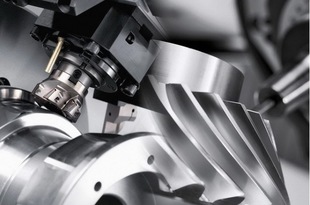
The skills of turning and milling composite processing are not fixed, it is an organic combination that requires the operator to fully utilize their imagination and hands-on ability, and is an innovative labor. Below are two processing tips shared by Yamei Precision:
1. Part processing sequence:
Drill first and then flat end (this is to prevent material shrinkage during drilling);
First rough turning, then fine turning (this is to ensure the accuracy of the parts);
After machining with large tolerances, the machining tolerance is small (this is to ensure that the surface of small tolerance dimensions is not scratched and prevent part deformation).
2. Choose a reasonable speed, feed rate, and cutting depth based on the hardness of the material:
1) Carbon steel materials are selected for high speed, large feed, and deep cutting. For example: 1Gr11, select S1600, F0.2, 2mm cutting depth;
2) Choose low speed, low feed, and small cutting depth for hard alloys. For example: GH4033, select S800, F0.08, and cut 0.5mm deep;
3) For titanium alloys, choose low speed, high feed rate, and small cutting depth. For example: Ti6, select S400, F0.2, and cut at a depth of 0.3mm. Taking the processing of a part as an example: the material is K414, which is a very hard material. After multiple tests, S360, F0.1, and a cutting depth of 0.2 were ultimately selected. Only qualified parts can be processed.
Mastering the skills of turning and milling composite machining is a gradual process. It is based on mastering the basic operation of machine tools, basic mechanical processing knowledge, and basic programming knowledge.
What is generative milling in precision parts processing
Basic steps of milling machine fixtures in precision parts processing
Related Article

Let us go over the foundations of the electroplating procedure. Electroplating involves several phases, and from pre-treatment to post-treatment there are several really significant ones.
The basic principle of surface treatment of precision parts in CNC machining

Audio panels, electronic cigarette shells, nameplateLOG, watch shells, etc. are among the CNC processing of high surface texture needs components.
CNC machining aluminum alloy parts high-quality surface texture process explained in detail

Metallic finishing, sometimes known as metallic finishing, is the process of using several techniques to change the surface of an object in order to improve appearance and performance, such as corrosion resistance, discoloration resistance, chemical resistance, abrasion resistance, and hardness, modify electrical conductivity, remove burrs, or apply a specific color to a machined part.
Metal CNC finishing surface treatment process and its working principle
