
The working principle of wire cutting machining
author: Hansheng Automation
2023-05-20
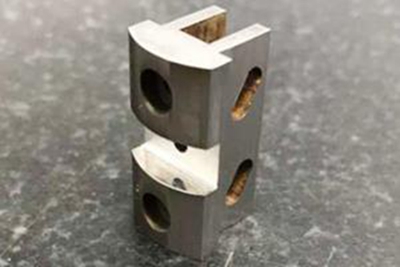
Wire cutting technology is a special machining technology in industrial production. Unlike traditional machining techniques that require mechanical energy for cutting, this technology mainly utilizes the thermal energy generated by the discharge of electric sparks in electrical energy to achieve material cutting, separation, and extraction. So the electric discharge wire cutting technology is not limited by materials and can process any metal material with any conductive properties at will. Therefore, wire cutting technology plays a very important role in China's industrial production and mechanical processing.
The working principle of wire cutting machine tools is a process of separating metal materials by melting them after the heat generated by electric spark discharge reaches the melting point of the metal material. It was invented by the former Soviet Union in the last century, but for the first time in China, this technology was applied to industrial production.
According to different process technologies, wire cutting can be divided into slow wire cutting, fast wire cutting, and medium wire cutting. The difficulty of processing workpiece materials in online cutting is independent of the metal hardness of the processed material, as there is no significant physical mechanical cutting force during the cutting process. This technology can be used to process all conductive materials such as alloys with higher hardness.
However, there is a limit to the minimum corner radius of the workpiece being processed. The minimum radius in wire cutting machining is the radius of the electrode wire plus the gap between the machining bay and the operating platform. In actual machining, the shape of wire cutting is formed by moving the workbench according to the predetermined control program. This can only process the contour shape of the workpiece, and the remaining remaining materials can still be used.
Wire cutting machining is a process in which conductive extremely fine moving metal is used as electrodes, and new electrode wires can be continuously replaced. The metal electrode wires that are lost in the processing area are formed by spark discharge cutting on the processed workpiece. This moving electrode wire avoids the impact of electrode loss on processing accuracy. At present, wire cutting technology can only be used for through-hole and edge machining, and can be used for drilling and cutting various complex parts.
In the era of the development of online cutting technology, with the development of society and the progress of science and technology, various fields of wire cutting have also been widely promoted. All of these products used in wire cutting, therefore, wire cutting processing is the most important link in the socialized production of related industries. Nowadays, with the development of wire cutting processing in China, it has made significant progress.
What are the positioning benchmarks for machining shaft parts
Development Trend of Precision Parts Processing
Related Article

Let us go over the foundations of the electroplating procedure. Electroplating involves several phases, and from pre-treatment to post-treatment there are several really significant ones.
The basic principle of surface treatment of precision parts in CNC machining

Audio panels, electronic cigarette shells, nameplateLOG, watch shells, etc. are among the CNC processing of high surface texture needs components.
CNC machining aluminum alloy parts high-quality surface texture process explained in detail

Metallic finishing, sometimes known as metallic finishing, is the process of using several techniques to change the surface of an object in order to improve appearance and performance, such as corrosion resistance, discoloration resistance, chemical resistance, abrasion resistance, and hardness, modify electrical conductivity, remove burrs, or apply a specific color to a machined part.
Metal CNC finishing surface treatment process and its working principle
