
The influence of water quality on cutting fluid during metal processing
author: Hansheng Automation
2023-05-10
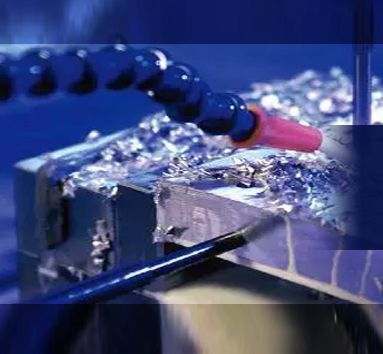
Cutting and grinding fluids require dilution and usually require a large amount of water (95% water content is a typical concentration), where water plays an important role in the performance of cutting fluids. If the water quality of each customer is the same, things would be simpler. However, the water quality in China varies, and we need to understand how water affects cutting fluids.
Water is composed of two hydrogen atoms and one oxygen atom, and is a polar compound described as the "most popular solvent" in various technical materials. However, the water quality depends on the water source and the treatment process of the local water plant.
In the metal processing process, we rely on water to remove the heat generated by cutting tools and workpieces. At the same time, water can also serve as a carrier for additives such as corrosion inhibitors, lubricants, cleaning agents, and fungicides. In the application of cutting fluids, water has some important parameters such as hardness, conductivity, pH, alkali value, temperature, and cleanliness As the usage time increases, these parameters will eventually reach an equilibrium state, and the equilibrium value depends on the evaporation, overflow, splashing, workpiece removal, heat, and the amount of coolant used, all of which will affect the highest direction of these parameters.
hardness
Hardness is a measure of the content of calcium (Ca) and magnesium (Mg) ions in water, expressed in terms of calcium carbonate These are naturally occurring cations that come from minerals underground. You can express the hardness value as either German degrees or ppm (parts per million), where a unit of ppm is equivalent to milligrams and a liter of German degrees is equivalent to 17ppm. In the continental United States, the hardness can be as low as 2-5 ppm in the southeastern United States to 1200-1500 ppm in the southeastern desert.
The biggest problem is that too high hardness can cause instability in the emulsion, and excessive calcium and magnesium ions can form "hard water soaps". These soaps are usually insoluble in water and can lead to the production of viscous residues. At this time, hardness can be chelated by additives, which are called chelating agents. Chelating means that calcium and magnesium ions react chemically with reagents, so they no longer react with other components in the coolant.
There are multiple analytical methods to determine the total hardness in a solution, and the commonly used method in our field is the hardness test paper.
conductivity
Conductivity is used to measure the electronic activity in total dissolved solids (ie.TDS) in aqueous solution. The conductivity is measured by measuring the micro Siemens per unit( μ S) A micro ohm is a bridge that passes through it, (a micro ohm is divided by one ohm, hence the name "mOhm"). A micro ohm is equivalent to μ M'o.
Although these ions exist in nature, there are also some chloride ions and sulfate ions carried over from other liquids and components (see chloride ions and sulfate ions section for details), and iron ions come from the grinding and cutting processes of iron equipment and steel and cast iron.
Similar to high hardness, high conductivity can also disrupt the stability of emulsions, which is actually a component of wastewater treatment. Concentrated aluminum sulfate (alum) and iron chloride are used for emulsion demulsification.
pH
In general, most water has a pH range of around 5.7 to 8.0. pH values do not require much attention unless it has a relatively high alkalinity.
Alkali value
The basic value of water is generally believed to come from carbonates. However, the main concern is that when the basic value of water is high enough, it will affect the titration of the basic value. In this case, we must ensure that the basic value of water is subtracted from the total basic value.
Chloride ions and sulfates
High conductivity, especially chloride ions and sulfates, can increase corrosion issues. Unfortunately, the only way to reduce the concentration of chloride ions and sulfates is through partial discharge, and you can also treat these ions as pollutants and remove them before water enters the workshop.nce of these ions can be measured using specific electrodes. This is also a laboratory method called Volhard used to determine the presence of these ions in solutions.
Chloride ions and sulfates exist in nature, but other chemical liquids may bring these ions. Heating treatment can increase chloride ions, and some cleaning agents can also bring chloride ions.
Temperature&Mixing 1
Cold water often makes emulsions difficult to use, and some cases indicate that some products cannot be mixed at all in cold water. In winter, when the water temperature drops to 4-10oC, the problem with cold water is obvious.
Some customers and processes require the metal working fluid to be cooled to a lower temperature than normal temperature, in order to maintain consistent workpiece temperature. You have found that there are very strict precision tolerance requirements in some aviation applications.
workmanship
There are different processes used to improve water quality, and deionization is particularly common when our customers apply these processes. Deionized (DI) water is a type of water that undergoes a condensation process to remove all ions. This water typically has a hardness of less than 5ppm and does not contain ions that are not conducive to emulsification performance The disadvantage is that these waters are more likely to produce foam for some products.
Another process is called softening, as its name suggests, where hard water ions are removed. However, in this ion exchange process, sodium ions replace calcium and magnesium ions, so although you can use soft water, the conductivity still increases.
The last type of process is called reverse osmosis (RO) RO water process is a physical process where "barrier" ions pass through a special type of membrane. The quality of RO water is very similar to that of DI water.
As you can see, we highly rely on these difficult to control things, but if we arm ourselves with the experience and knowledge discussed above, we can inform customers in advance about the impact of water quality on their processes. Secondly, a comprehensive understanding of customer process is also very important for our product selection.
What are the requirements for precision parts processing
Be careful with dry weather and dry materials. Laser cutting machine and water cooling machine
Related Article

Let us go over the foundations of the electroplating procedure. Electroplating involves several phases, and from pre-treatment to post-treatment there are several really significant ones.
The basic principle of surface treatment of precision parts in CNC machining

Audio panels, electronic cigarette shells, nameplateLOG, watch shells, etc. are among the CNC processing of high surface texture needs components.
CNC machining aluminum alloy parts high-quality surface texture process explained in detail

Metallic finishing, sometimes known as metallic finishing, is the process of using several techniques to change the surface of an object in order to improve appearance and performance, such as corrosion resistance, discoloration resistance, chemical resistance, abrasion resistance, and hardness, modify electrical conductivity, remove burrs, or apply a specific color to a machined part.
Metal CNC finishing surface treatment process and its working principle
