
Process Adaptability of Dongguan CNC Precision Processing Factory
author: Hansheng Automation
2023-05-11
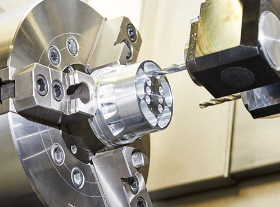
Based on the advantages and disadvantages of CNC machining at Dongguan CNC Precision Machining Factory and a large number of application practices at home and abroad, parts can generally be divided into the following three categories according to the degree of process adaptability.
1. Most adaptable class
1. Parts with complex shapes and high processing accuracy requirements that cannot be processed with universal processing equipment or that, although capable of processing, are difficult to ensure product quality;
2. Complex curve or surface contour parts described using mathematical models
3. Shell or box shaped parts with non open inner cavities that are difficult to measure, control feed, or control dimensions;
4. Parts that require multiple processes such as milling, boring, reaming, or threading to be combined in one clamping process.
For the above parts, it is advisable not to overly consider productivity and economic rationality, but rather to consider whether they can be processed and focus on the possibility. Whenever possible, the use of CNC machining should be considered as the preferred solution.
2. More adaptable
1. Parts that are susceptible to human interference during processing on general-purpose machine tools, have high value, and can cause significant economic losses once the quality is out of control;
2. Processing parts that require complex specialized tooling on universal machine tools:
3. Parts that require multiple design changes to be finalized;
4. Processing parts that require long-term adjustment on universal machine tools;
When using universal machine tools to process parts with low productivity or high physical labor intensity.
After analyzing their machinability, these types of parts need to be comprehensively evaluated in terms of improving productivity and economic benefits. Generally, they can be considered as the main selection objects for CNC machining.
3. Inadaptable class
1. Produce large quantities of parts (of course, it is not ruled out that some of the processes are processed using CNC machine tools);
2. Parts that are difficult to clamp or rely solely on alignment and positioning to ensure machining accuracy:
3. Parts with unstable machining allowance and no online detection system on CNC machine tools that can automatically adjust the coordinate position of the parts;
4. Specific process equipment must be used to coordinate the parts processed by Dongguan CNC Precision Processing Factory.
What measures should Dongguan CNC Precision Processing Factory take during high-speed machining
Steps for formulating part processes in precision parts processing
Related Article

Let us go over the foundations of the electroplating procedure. Electroplating involves several phases, and from pre-treatment to post-treatment there are several really significant ones.
The basic principle of surface treatment of precision parts in CNC machining

Audio panels, electronic cigarette shells, nameplateLOG, watch shells, etc. are among the CNC processing of high surface texture needs components.
CNC machining aluminum alloy parts high-quality surface texture process explained in detail

Metallic finishing, sometimes known as metallic finishing, is the process of using several techniques to change the surface of an object in order to improve appearance and performance, such as corrosion resistance, discoloration resistance, chemical resistance, abrasion resistance, and hardness, modify electrical conductivity, remove burrs, or apply a specific color to a machined part.
Metal CNC finishing surface treatment process and its working principle
