
Principles and lubrication requirements of harmonic reducers
author: Hansheng Automation
2023-05-09
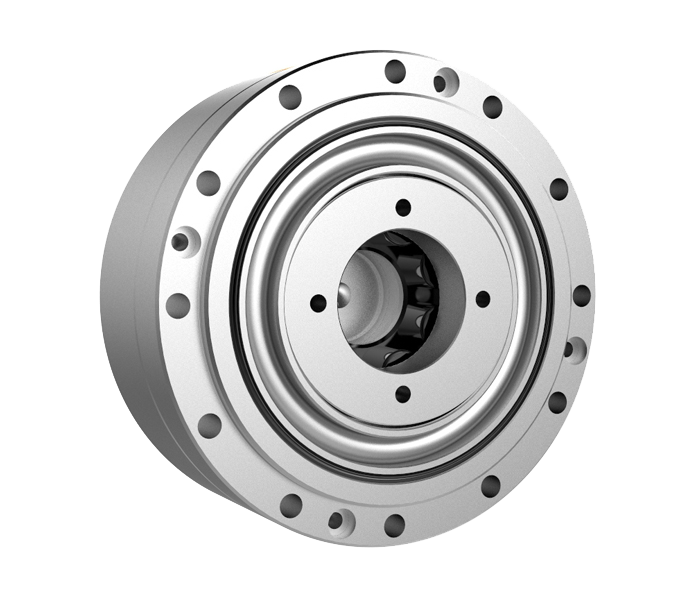
The principle of the reducer: The meshing process of the flexible gear teeth and the rigid gear teeth at the pitch circle is like two pure rolling (non sliding) rings, and both must have an equal arc length when rotating on the pitch circle at any moment. Due to the fact that the flexible wheel has two less tooth pitches on the pitch circumference than the rigid wheel, during the meshing process, the flexible wheel must rotate two tooth pitch angular displacements relative to the rigid wheel. This angular displacement is precisely the rotation of the output shaft of the reducer, thus achieving the purpose of deceleration.
Structural features: small size, light weight, large transmission ratio, high accuracy, stable transmission, and high efficiency
Application fields: light industrial robots/robotic arms, precision measurement devices, precision transmission systems with volume requirements
Component composition:
Lubrication requirements for harmonic reducers
Extreme pressure and wear resistance:
The harmonic reducer needs to start and stop frequently and move back and forth frequently, which can easily cause wear and reduce accuracy. Therefore, it is required that the lubricating grease must have excellent extreme pressure and anti wear performance.
Thermal stability performance:
The joint structure of industrial robots is compact, with poor heat dissipation, and prolonged continuous operation causes high temperature in the joint area. Lubricating grease is required to have good thermal stability and oxidation stability.
Long lifespan:
The harmonic reducer needs to be frequently started and reciprocated in a small space to withstand high-speed and high load operation, which requires the grease to have long life lubrication, without carbon accumulation, discoloration, and oil separation.
Noise reduction:
The harmonic reducer generates strong noise due to friction, vibration, and collision of the transmission gears, requiring the lubricating grease to have extremely strong oil film thickness and adhesion, effectively reducing noise.
Comparison of grease wear spot diameters
DRSLSK-1A lubricating grease uses synthetic oil as the base oil, which has better low-temperature performance and lubrication performance; Organic molybdenum composite additives have excellent wear resistance and extreme pressure performance, while not corroding metals, effectively improving the service life of harmonic gearboxes.
Main characteristics of harmonic reducer products
What industries are harmonic reducers suitable for
Related Article

Let us go over the foundations of the electroplating procedure. Electroplating involves several phases, and from pre-treatment to post-treatment there are several really significant ones.
The basic principle of surface treatment of precision parts in CNC machining

Audio panels, electronic cigarette shells, nameplateLOG, watch shells, etc. are among the CNC processing of high surface texture needs components.
CNC machining aluminum alloy parts high-quality surface texture process explained in detail

Metallic finishing, sometimes known as metallic finishing, is the process of using several techniques to change the surface of an object in order to improve appearance and performance, such as corrosion resistance, discoloration resistance, chemical resistance, abrasion resistance, and hardness, modify electrical conductivity, remove burrs, or apply a specific color to a machined part.
Metal CNC finishing surface treatment process and its working principle
