
Origin of workpiece coordinate system in precision part machining
author: Hansheng Automation
2023-05-15
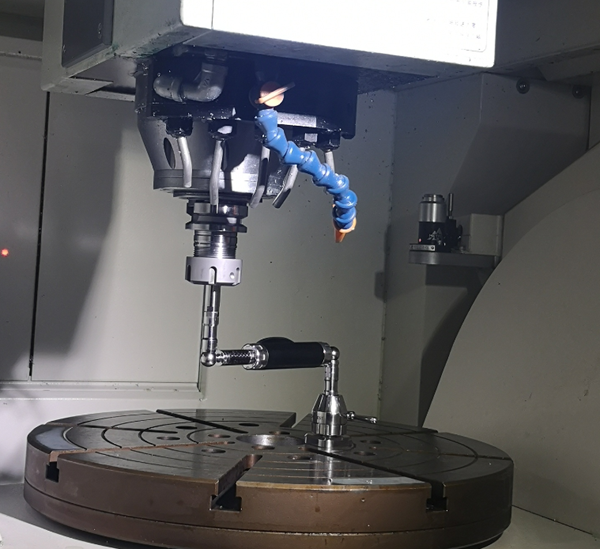
In precision parts processing, the programming and calculation origin for determining the workpiece contour on the workpiece coordinate system is called the workpiece coordinate system origin, abbreviated as the workpiece origin, also known as the programming zero point. In processing, the position of the workpiece coordinate system in the machine tool coordinate system is also determined because the clamping position of the workpiece is fixed relative to the machine tool.
On CNC machine tools such as boring and milling in precision parts processing, both G92 instruction and G45-G95 instruction are used to set the workpiece machining coordinate system, but they are different in use. G92 instruction sets the workpiece machining coordinate system through a program; The G54-G59 instruction sets the workpiece machining coordinate system through CRT/MDI in the parameter setting mode. Once the workpiece coordinate system is set, the position of the machining coordinate origin in the machine coordinate system remains unchanged, and it is independent of the current position of the tool, unless it is changed through CRT/MDI again. The G92 instruction program segment only sets the machining coordinate system without generating any actions; The G54-G59 instruction program segment can be combined with the G00 and G01 instructions to perform displacement in the selected machining coordinate system.
Introduction to CNC machining programming operation process
Measurement methods in precision parts machining and milling
Related Article

Let us go over the foundations of the electroplating procedure. Electroplating involves several phases, and from pre-treatment to post-treatment there are several really significant ones.
The basic principle of surface treatment of precision parts in CNC machining

Audio panels, electronic cigarette shells, nameplateLOG, watch shells, etc. are among the CNC processing of high surface texture needs components.
CNC machining aluminum alloy parts high-quality surface texture process explained in detail

Metallic finishing, sometimes known as metallic finishing, is the process of using several techniques to change the surface of an object in order to improve appearance and performance, such as corrosion resistance, discoloration resistance, chemical resistance, abrasion resistance, and hardness, modify electrical conductivity, remove burrs, or apply a specific color to a machined part.
Metal CNC finishing surface treatment process and its working principle
