
What Is a Timing Belt
2025-07-15
What Is a Timing Belt?
In the world of mechanical engineering and power transmission, timing belts play a critical role in ensuring precision, efficiency, and reliability. From the engine under your car’s hood to the conveyor belts in factories, these seemingly simple components are the unsung heroes that keep machines running in perfect sync. But what exactly is a timing belt, and how does it differ from other types of belts or chains? This guide will break down everything you need to know—from its basic definition to its inner workings, types, applications, and maintenance.
Defining the Timing Belt: More Than Just a Belt
A timing belt, also known as a synchronous belt, is a toothed belt designed to transmit power between two or more rotating shafts with zero slippage. Unlike friction-driven belts (such as V-belts or flat belts), which rely on tension and friction to transfer motion, timing belts use a series of evenly spaced teeth that interlock with corresponding grooves on pulleys (called timing pulleys). This tooth-to-groove engagement creates a rigid connection, ensuring that the driving and driven shafts rotate at precisely the same speed and in perfect synchronization.
The key distinction here is synchronous motion. In machines where timing is critical—like an internal combustion engine, where valves must open and close exactly as pistons move—even a tiny slip can cause catastrophic damage. Timing belts eliminate this risk, making them indispensable in high-precision applications.

The Anatomy of a Timing Belt: What Makes It Work?
A timing belt’s performance depends on its carefully engineered structure. While designs vary by application, most timing belts share three core components:
1. Tooth Layer: The Driving Force
The toothed surface is the belt’s most defining feature. Its design directly impacts grip, durability, and compatibility with pulleys. Key characteristics include:
- Tooth Profile: Shapes like trapezoidal (T-type), curvilinear (HTD, STD), or round (RPP) are optimized for specific loads. For example, curvilinear teeth distribute stress more evenly, making them ideal for high-torque applications like industrial robots.
- Pitch: The distance between the centers of adjacent teeth (e.g., 2mm, 5mm, 8mm). This must match the pulley’s pitch to ensure proper meshing.
- Tooth Count: Determines the belt’s length and the ratio of power transmission between shafts.
2. Tension Layer: Strength and Flexibility
Beneath the tooth layer lies a tension member, typically made of:
- Glass Fiber: Offers high tensile strength (up to 3,000 MPa) and low elongation, making it suitable for moderate loads in appliances or office equipment.
- Kevlar: Boasts even greater strength (up to 3,620 MPa) and heat resistance, ideal for high-performance engines or heavy machinery.
- Steel Cord: Used in extreme-load scenarios, such as industrial presses, where rigidity and durability are paramount.
3. Backing and Cover: Protection and Stability
The outer layer (backing) protects the tension layer from abrasion, chemicals, and temperature fluctuations. Materials include:
- Neoprene: Resistant to oil and ozone, common in automotive engines.
- Polyurethane (PU): Offers superior wear resistance and operates in a wider temperature range (-30°C to 80°C), making it perfect for food processing machinery (where cleanliness is critical).
- Nylon Fabric: Added to the tooth surface to reduce friction between the belt and pulley, extending service life.
How Does a Timing Belt Work?
At its core, a timing belt’s function is to create a positive drive system—meaning power is transferred through mechanical contact (tooth meshing) rather than friction. Here’s a step-by-step breakdown:
- Meshing: The belt’s teeth fit into the grooves of the driving pulley (connected to a motor or engine) and the driven pulley (connected to a component like a camshaft or conveyor roller).
- Synchronous Rotation: As the driving pulley turns, its teeth pull the belt’s teeth, rotating the driven pulley at a precise speed. The ratio of rotation (gear ratio) is determined by the number of teeth on each pulley. For example, a driving pulley with 20 teeth and a driven pulley with 40 teeth will reduce speed by half while doubling torque.
- Tension Maintenance: A tensioner pulley keeps the belt tight, preventing slack that could cause tooth skipping or premature wear. Proper tension ensures the belt remains engaged without excessive stress on the tension layer.
Types of Timing Belts: Choosing the Right One
Timing belts are categorized by international standards, each designed for specific applications:
1. Trapezoidal (T-Type) Belts
- Design: Flat-topped teeth with straight sides (60° angle).
- Common Sizes: T2.5, T5, T10 (pitch in mm).
- Best For: Light to medium loads in 3D printers, small conveyor systems, or office equipment. Their simple design makes them cost-effective for low-torque tasks.
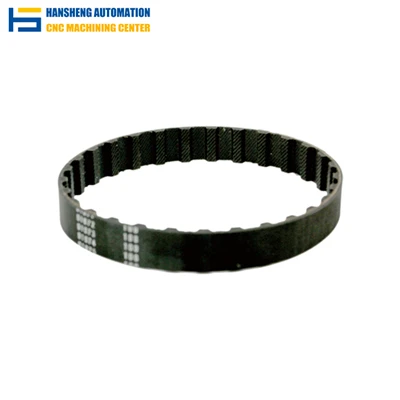
2. High Torque Drive (HTD) Belts
- Design: Curved teeth (circular arc) to distribute load evenly.
- Common Sizes: 3M, 5M, 8M (pitch in mm).
- Best For: High-torque industrial machinery, such as CNC routers or robotic arms. The curved profile reduces stress on individual teeth, allowing them to handle up to 50% more torque than T-type belts.

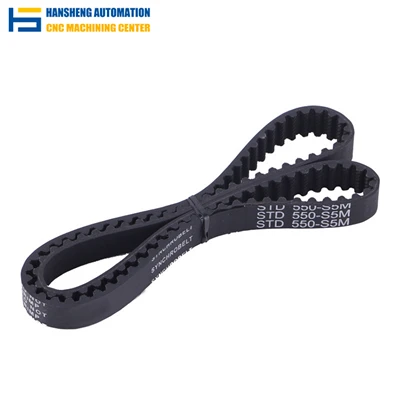
3. Super Torque Drive (STD) Belts
- Design: Modified curvilinear teeth with a larger contact area.
- Common Sizes: 8M, 14M.
- Best For: Heavy-duty applications like mining equipment or large-scale manufacturing lines. They excel in high-vibration environments where durability is critical.
4. Round Pitch (RPP) Belts
- Design: semi-circular teeth that minimize noise and wear.
- Common Sizes: RPP3, RPP5.
- Best For: Precision instruments, medical devices, or any application where quiet operation is essential (e.g., laboratory equipment).
Applications: Where Timing Belts Shine
Timing belts are ubiquitous across industries due to their precision and versatility. Here are their most common uses:
1. Automotive Engines
- Role: Synchronize the crankshaft (which drives pistons) and camshaft (which controls valves). In interference engines, a failed timing belt can cause pistons to collide with valves, leading to costly damage.
- Examples: Most modern cars use timing belts (or chains) with replacement intervals of 60,000–100,000 miles, depending on the model. High-performance engines often use Kevlar-reinforced belts to handle higher RPMs.
2. Industrial Machinery
- Role: Power conveyors, packaging machines, and assembly lines. Their ability to maintain speed accuracy (±0.5%) makes them ideal for automated systems.
- Examples: A food-grade PU timing belt with a 5mm pitch might drive a conveyor in a bakery, ensuring consistent spacing between loaves.
3. Robotics and Automation
- Role: Transmit motion in robotic arms, linear actuators, and CNC machines. Their low backlash (less than 0.1mm) ensures precise positioning.
- Examples: Collaborative robots (cobots) use HTD 3M belts in their joints to achieve smooth, repeatable movements.
4. Household Appliances
- Role: Drive components in washing machines, dryers, and vacuum cleaners. Their quiet operation and low maintenance make them consumer-friendly.
- Examples: A T5 timing belt in a washing machine’s drum assembly ensures the agitator and spin cycle work in perfect harmony.
Timing Belts vs. Other Power Transmission Methods
How does a timing belt stack up against chains, gears, or V-belts? Here’s a quick comparison:
|
Feature
|
Timing Belt
|
Chain Drive
|
Gear Drive
|
V-Belt
|
|
Slippage
|
None (positive drive)
|
Minimal (with lubrication)
|
None
|
Common (friction-driven)
|
|
Noise
|
Low (no metal-on-metal contact)
|
High (needs lubrication)
|
High (metal meshing)
|
Moderate (friction noise)
|
|
Maintenance
|
Low (no lubrication)
|
High (lubrication, cleaning)
|
Low (sealed systems)
|
Moderate (tension checks)
|
|
Cost
|
Moderate
|
High
|
High
|
Low
|
|
Best For
|
Precision, low noise
|
Heavy loads, high durability
|
Extreme torque, compact spaces
|
Low-cost, non-critical tasks
|
Maintaining Your Timing Belt: Tips for Longevity
A well-maintained timing belt can last 5–10 years (or 60,000–150,000 miles in cars). Follow these steps to maximize its lifespan:
1. Regular Inspections
- Frequency: Check every 6 months (or 10,000 miles for automotive use).
- What to Look For: Cracks in the tooth layer, fraying of the backing, or glazing (a shiny surface indicating overheating). Tension should be firm but not overly tight—pressing the belt midway between pulleys should deflect 1/64 inch per inch of span (e.g., 1/4 inch for a 16-inch span).
2. Proper Installation
- Alignment: Pulleys must be parallel; misalignment by just 1° can reduce belt life by 50%. Use a straightedge to ensure pulleys line up.
- Tension: Over-tightening strains the tension layer; under-tightening causes tooth skipping. Use a tension gauge (aim for 5–10% of the belt’s tensile strength).
3. Environmental Control
- Temperature: Avoid exposing belts to extremes (-30°C to 80°C for PU; -50°C to 120°C for neoprene).
- Chemicals: Keep belts away from oil, gasoline, or solvents—they can degrade rubber and polyurethane.
- Debris: Clean pulleys regularly to remove dirt that can wear down teeth.
Common Timing Belt Problems and Solutions
Even with proper care, issues can arise. Here’s how to troubleshoot:
1. Tooth Wear or Chipping
- Causes: Misalignment, excessive load, or abrasive debris.
- Fix: Realign pulleys, reduce load, or install a debris shield. Replace the belt if wear exceeds 20% of tooth height.
2. Belt Slipping or Skipping Teeth
- Causes: Low tension, worn tensioner, or damaged teeth.
- Fix: Adjust tension, replace the tensioner, or install a new belt. For automotive systems, a slipping belt may trigger a check engine light.
3. Belt Breakage
- Causes: Over-tensioning, fatigue from age, or exposure to chemicals.
- Fix: Replace the belt immediately. In cars, always replace the tensioner and idler pulleys when installing a new timing belt—worn pulleys can damage the new belt.
Conclusion
A timing belt is far more than a simple loop of rubber—it’s a precision-engineered component that enables synchronized motion in countless machines. By understanding its design, types, and maintenance needs, you can ensure your timing belt system runs efficiently for years. Whether you’re maintaining a car engine, a 3D printer, or an industrial conveyor, the key is to choose the right belt for the job, install it correctly, and inspect it regularly. With these steps, you’ll harness the full power of synchronous drive technology.
How Do You Know If the Timing Belt Is Broken
How to Make a Pulley System
Related Article

Gears are the backbone of mechanical transmission systems, converting rotational motion and torque between shafts to power everything from household appliances to industrial machinery.
What are the 4 types of gears

CNC machines (Computer Numerical Control machines) have transformed manufacturing by delivering unmatched precision, repeatability, and efficiency across material types—from metals to plastics and composites.
Which Industries Mostly Use CNC Machines

CNC machining is celebrated for its precision and versatility in shaping metals, plastics, and composites—but its subtractive nature (removing material from a solid workpiece to create parts) raises a critical question: “Is CNC machining wasteful?” At first glance, the piles of metal shavings, plastic chips, and scrapped parts from CNC operations might suggest yes.
Is CNC machining wasteful
