
New Technology of CNC Turning Tools in Precision Parts Processing
author: Hansheng Automation
2023-05-11
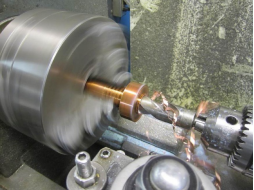
In precision parts processing, coating technology is a tool material obtained by coating a thin layer (5-12um thick) of high wear resistant refractory metal compound on the surface of ordinary hard alloy blades using chemical vapor deposition (CVD) or physical vapor deposition (PVD) methods.
The surface of high-speed steel cutting tools after precision parts processing is coated with a layer of 2-6um thick wear-resistant materials with high hardness and high melting point (such as TN, TiC, AL2O, etc.), which gives the tool surface much higher hardness than the substrate, greatly improving the wear resistance of the tool, increasing the tool service life by 2-10 times, and increasing the machining efficiency by 50-100%.
Due to the fact that the coating temperature (300-500 ℃) of PVD process is lower than the tempering temperature of high-speed steel, the hardness of the coated high-speed steel matrix does not decrease, and the geometric dimension accuracy of the cutting tool is controllable. Therefore, its development and application are rapid. The PVD method mainly uses the TN coating process. Coating technology is applicable to the following tools.
1) Complex tools that are reground along the front face, such as gear shapers, hobs, forming tools, and broaches, are mainly worn on the back face. After regrinding along the front face, the coating on the back face is retained, and the reduction in tool life is smaller than that of regrinding along the back face. Compared with uncoated tools, their lifespan can still be increased by about 2 times, which is economically reasonable.
2) Tools used for manufacturing difficult to machine materials, such as drills, taps, etc. Coated high-speed steel tools can directly process quenched and tempered medium hard (hardness less than or equal to 42HRC) blanks
What are the requirements for precision parts processing
What is the MRP method used in precision parts processing
Related Article

Let us go over the foundations of the electroplating procedure. Electroplating involves several phases, and from pre-treatment to post-treatment there are several really significant ones.
The basic principle of surface treatment of precision parts in CNC machining

Audio panels, electronic cigarette shells, nameplateLOG, watch shells, etc. are among the CNC processing of high surface texture needs components.
CNC machining aluminum alloy parts high-quality surface texture process explained in detail

Metallic finishing, sometimes known as metallic finishing, is the process of using several techniques to change the surface of an object in order to improve appearance and performance, such as corrosion resistance, discoloration resistance, chemical resistance, abrasion resistance, and hardness, modify electrical conductivity, remove burrs, or apply a specific color to a machined part.
Metal CNC finishing surface treatment process and its working principle
